Agentic AI Methodologies
Eight levers, what they owe to human organization, and a matrix to choose by situation
Dozens of agentic methods reduce to the setting of eight levers. This report tests that idea on real systems, traces what the levers owe to human organization, and ends on a matrix for choosing a configuration by situation.

The report in 5 parts
- Part I · Chapters 1 to 4What an agent is, and what this report sets out to doWhat counts as AI, where a model becomes an agent, and the vocabulary this report fixes before it argues anything.
- Part II · Chapters 5 to 15One loop under every agent, and eight levers to configure itOne loop underlies every agent. Eight levers configure it, and a test on two real coding agents shows that they describe real differences.
- Part III · Chapters 16 to 20The vendors' catalogue, read as settings of the leversPatterns, frameworks and standards read as settings of the eight levers, with the disagreements that divide the field and the state of the evidence.
- Part IV · Chapters 21 to 26What agents owe to human organization, and where the likeness endsWhat agentic systems borrow from human organizations, what a model brings that no organization has had to handle, and where an agent fits in a team led by people.
- Part V · Chapters 27 to 33Cost decides, and the situation sets the dialsCost is what decides between configurations. Decision rules, tools for each lever, documented cases, and the matrix that the research produces.
Downloads
Agentic artificial intelligence methodologies are transitioning from exploratory prototypes to production systems. Beneath dozens of competing frameworks and commercial taxonomies lies a single, irreducible first principle: a continuous loop of tool use, planning, and reflection (The Batch 241). This shared cognitive foundation means that abstract capability taxonomies fail to discriminate between systems. An agent that runs Monte Carlo tree search and a basic loop with retries are described in the same words by such taxonomies (Inside the Scaffold, arXiv 2604.03515). Architecture describes how production methodologies differ. What decides between them is their economic boundary: the cost in tokens, latency, and human attention required to enforce reliability. This report works through the fragmentation of the field with three core hypotheses, three empirical pivot findings, and a unified design framework.
The three hypotheses and their verdicts
The investigation tracked three foundational hypotheses regarding the structure, organizational origin, and delegation limits of autonomous agents. Each hypothesis began as an open inquiry during scoping and was systematically refined against empirical literature:
- H1 (Reducibility: from taxonomy to design framework). The diverse catalog of agentic methodologies reduces to eight invariant structural levers: Context, Action capability, Control loop, Decomposition and specialization, Verification and conformance, State persistence, Capability evolution, and Human control. Applied to two opposed coding agents, the levers separate them on most dials, so they describe real differences. They do not sort agents into species, because agents sit on continuous spectra and combine the same building blocks. The levers are a design grid, which Part V sets against the 31 layers of a tool catalogue compiled for this report.
- H2 (Organizational convergence: real resemblance, unnecessary convergence). Frameworks explicitly borrow structures from human institutions, including standard operating procedures (
Code = SOP(Team)), assembly-line handoffs, and organizational divisions of labor (MetaGPT, arXiv 2308.00352). However, convergence is partial and unnecessary. Agentic systems face an irreducibly distinct layer of model-specific failures without human equivalent: reasoning-trace unfaithfulness (Anthropic), prompt injection vulnerabilities (arXiv 2510.09023), context degradation, and multi-turn role drift (arXiv 2512.07665). - H3 (Delegation boundary: indecision as an empirical result). Human organizations rely on social reputation and long-horizon career incentives to ensure alignment. Software engineering provides functional substitutes for accountability through immutable audit traces and operator takeover (AI Act, art. 14), and replaces tacit context at high documentation cost. Yet, no operational substitute exists for social reputation or career ambition. Whether this delegation boundary reflects temporary engineering limits or universal structural constraints remains unresolved, and documenting this indecision is an explicit empirical result (MAST, arXiv 2503.13657).
Three pivotal findings
All three hypotheses converge on a shared reality: production agentic systems are constrained primarily by economics and containment. The report anchors its design rules on three controlled findings from recent literature:
- Token consumption dictates performance. On complex research benchmarks, token consumption alone explains 80 % of the performance variance across configurations (Anthropic). By the same vendor’s account, a multi-agent system uses about 15× the tokens of a chat exchange, where a single agent uses about four times.
- Per-turn human supervision fails in production. Production telemetry reveals that human operators grant roughly 93 % reflex approvals when subjected to frequent permission prompts (Anthropic). High prompt frequency induces supervision fatigue, transforming safety checkpoints into thoughtless clicks. Containment must rely on capability isolation, virtual machines, and network sandboxes rather than manual approvals.
- Runtime trajectory conformance remains unsolved. Across 12 published prompt-injection defenses, all 12 are bypassed at rates above 90 % under adaptive evaluations (The Attacker Moves Second, arXiv 2510.09023). Verifying agent actions after execution is tooled; verifying adherence to a prescribed execution path in flight remains an open vulnerability.
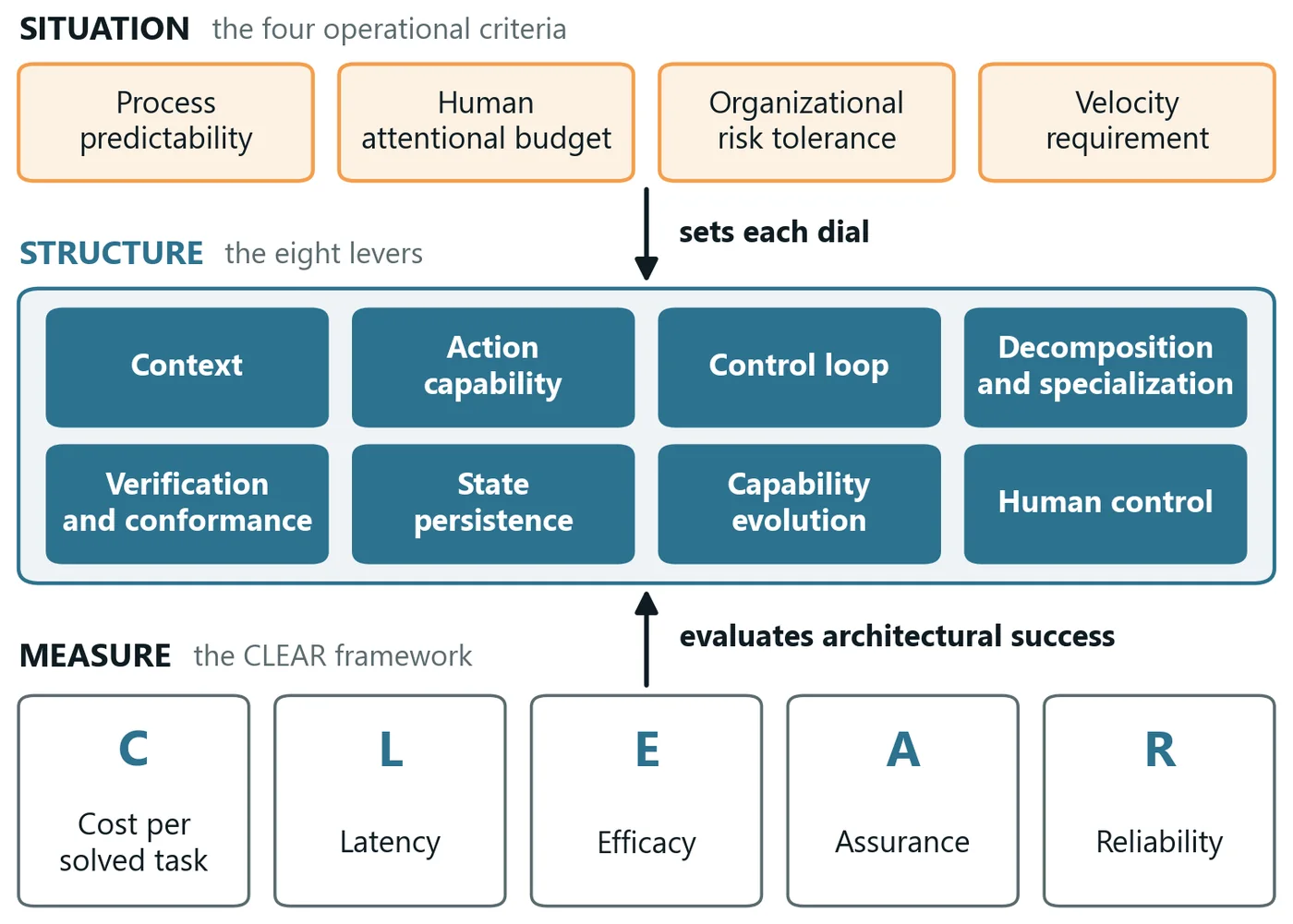 Figure 0.1: The situation sets each of the eight levers, and the five dimensions of the CLEAR framework evaluate the result. Diagram drawn by this report.
The situational architecture framework
To replace trial-and-error prototyping, the report synthesizes these findings into the Situational Architecture Triangle, connecting structural mechanisms, situational criteria, and multidimensional measurement (arXiv 2511.14136). The framework balances three interconnected pillars:
- Structure (The Eight Levers). Systems are configured across the eight levers, setting explicit dials for context boundaries, action permissions, control loop determinism, sub-agent decomposition, automated verification, persistent state stores, capability updates, and human escalation gates.
- Situation (The Four Operational Criteria). The optimal setting of each dial depends entirely on the operating environment:
- Process Predictability: The degree to which execution steps can be specified in advance.
- Human Attentional Budget: The cognitive capacity available to review outputs and handle escalations.
- Organizational Risk Tolerance: The cost of catastrophic or irreversible action failures.
- Velocity Requirement: The latency tolerance between trigger and final resolution.
- Measure (The CLEAR Framework). Architectural success cannot be evaluated through single-run accuracy benchmarks. The report adopts the multidimensional CLEAR framework (arXiv 2511.14136): Cost Per Solved Task, Latency, Efficacy (task completion rate), Assurance (guardrail trip rate), and Reliability (consistency across repeated runs).
The result, and the gaps it accepts
The result of the inquiry is a matrix, presented in the final chapter. For each of the eight levers it gives the question the lever asks, a default setting, the situation that justifies turning the dial, what turning it costs, and what stays with a human. A reference configuration for a mid-sized engineering team shows the matrix applied: a deterministic orchestrator for the overall process, a single agent that writes, and narrow model-driven steps inside a sandbox (Cognition). It is offered as a starting point and has not been tested in production.
The settings in that matrix are dated. On every lever, a documented change in 2025 or 2026 moved what is possible, from million-token context windows to classifiers that stand in for a human approver. The eight questions are the stable part of this report, and the answers have to be revisited as the tools change.
This methodology accepts five gaps:
- The literature lacks controlled comparisons evaluating diverse agent architectures at constant model capability and cost budgets.
- Trajectory conformance remains untooled, preventing systems from guaranteeing procedural compliance under untrusted inputs.
- Indirect prompt injection remains an active vulnerability without robust defense.
- The CLEAR framework and the proposed situational dials require extensive empirical validation across varied industry workloads.
- Whether what an agent cannot carry today marks a technical limit or a permanent one remains undecided.
The situational matrix
The research ends on one table. For each lever it gives the question the lever asks, a default setting, what justifies turning the dial, what turning it costs, and what stays with a human. Part V shows where each column comes from. The same matrix is in the workbook below, with the tools and the dated shifts behind it.
Table 33.1 The situational matrix
| Lever | The question it asks | Default setting | What justifies turning the dial | What turning it costs | What stays with a human |
|---|---|---|---|---|---|
| Context | What does the agent know when it decides? | Just-in-time retrieval | Low process predictability | Tokens, and diluted attention | Deciding what is worth writing down |
| Action capability | What can it do that cannot be undone? | Read-only; a person applies | High velocity, with risk tolerance to match | Exposure; a guarantee costs utility | Defining the perimeter |
| Control loop | Does code or the model decide the next step? | Code decides | Low process predictability | Unbounded, unpredictable runs | Deciding how wide the model’s space is |
| Decomposition and specialization | One executor or several, and along which cut? | One agent that writes alone | Contexts that work against each other | Coordination: about 15× the tokens of a chat | Choosing the cut and the roles |
| Verification and conformance | How are the product and the process checked? | Deterministic checks | Low risk tolerance | Tokens, latency, false alarms | Writing the reference to check against |
| State persistence | What survives the turn, the session, the crash? | Session-scoped | Tasks that span days or wait for a person | Complexity, and data to govern | Fixing what is kept and what is deleted |
| Capability evolution | What changes what the agent can do? | Static prompts and curated skills | A team too small to tune by hand | Drift, which has to be evaluated | Admitting a capability for good |
| Human control | Where does a person see and intervene? | A few gates before consequential actions | Volume beyond what people can read | Errors found after the fact | Approving the irreversible, and answering for it |
Sources cited on this page (12)
- AI Act, art. 14
- Anthropic, How we contain Claude
- Anthropic, multi-agent research system
- Anthropic, Reasoning models don't always say what they think
- arXiv 2511.14136
- arXiv 2512.07665
- Cognition
- Inside the Scaffold, arXiv 2604.03515
- MAST, arXiv 2503.13657
- MetaGPT, arXiv 2308.00352
- The Attacker Moves Second, arXiv 2510.09023
- The Batch 241