A 29,000 Payroll Miss Leaves Fed Policymakers Unmoved on Inflation
The United States economy added only 29,000 nonfarm payrolls in September, prompting markets to anticipate a pause in interest rate hikes, while Federal Reserve officials maintain their focus on persistent inflation driven by structural capital demands.
The United States economy’s lackluster job creation in September exposed a deep rift between financial markets declaring victory on rate hikes and a Federal Reserve quietly holding its line on inflation. Investors immediately priced in an October rate pause after the Bureau of Labor Statistics reported a severe miss in payroll additions. However, central bank policymakers are reading a different story in the underlying employment flows and the structural demands of the modern economy.
The Disconnect in September’s Job Numbers
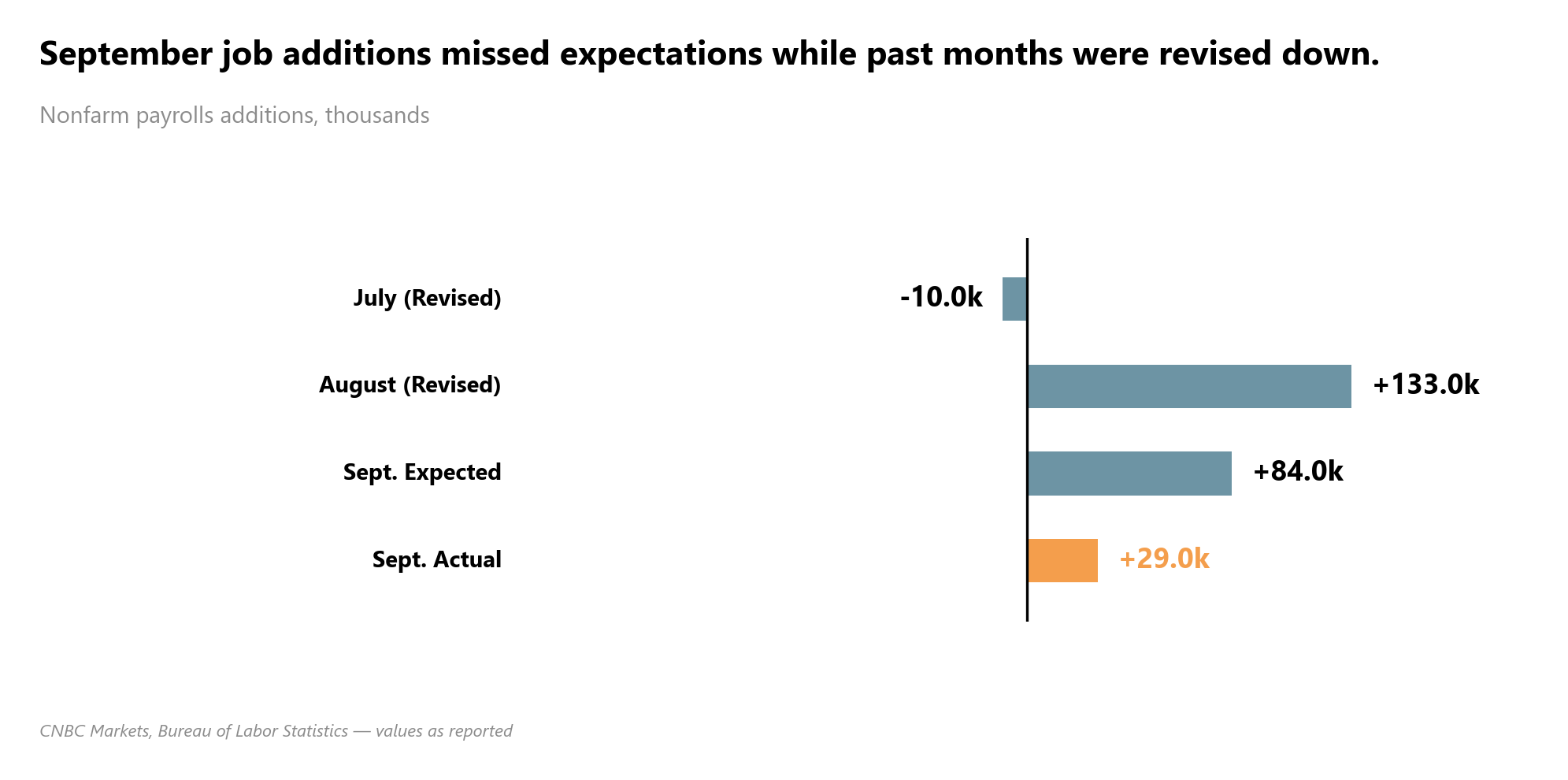
The headline employment figures for September presented a contradictory picture of the United States labor market. The establishment survey from the Bureau of Labor Statistics reported that nonfarm payrolls increased by a seasonally adjusted 29,000 jobs, according to CNBC Markets. That figure fell drastically short of the 84,000 additions expected by economists surveyed by Dow Jones. The weakness was compounded by downward revisions to previous months. The August count was adjusted lower to 133,000, and July was revised from a gain to a loss of 10,000 jobs, erasing a total of 60,000 previously reported positions.
Average hourly earnings also showed signs of cooling, with CNBC Markets reporting an increase of just 0.1 percent in September. That put the twelve month wage gain at 3.0 percent, marking the lowest annual reading since May 2021. The sectoral breakdown provided by CNBC Markets further emphasized the slowdown. Healthcare and construction managed to add jobs, but government employment fell by 17,000, temporary help services lost 11,000, and the information sector shed 10,000 positions.
At the same time, alternative measures of employment painted a significantly brighter picture. The ADP national employment report showed that private sector jobs rose by 90,000 in September, beating the Dow Jones consensus estimate of 68,000. Nela Richardson, chief economist at the payroll processing firm, noted that job creation rebounded after a three month slowdown and pay growth remained solid. Base pay rose 3.2 percent from a year ago, while gross pay accelerated by 4.7 percent. Service providers drove the bulk of that growth by adding 59,000 positions, effectively offsetting contractions in financial activities and professional services.
The dissonance between the two headline numbers becomes clearer when looking at the household survey and the underlying flow of workers. The official unemployment rate increased to 4.2 percent, but the precise, unrounded figures calculated by the St. Louis Fed research staff show a microscopic uptick from 4.141 percent to 4.175 percent. The research staff explained that this modest increase was not caused by a surge in layoffs. Instead, it was driven by the interplay between fewer unemployed people leaving the labor force and more unemployed people finding jobs.
The transition rate of unemployed people abandoning their job search dropped below its twelve month average, pushing the precise unemployment rate slightly higher. That upward pressure was partially offset by an above average rate of unemployed individuals securing employment. Furthermore, CNBC Markets highlighted that the household survey indicated the labor force swelled by 485,000 people, pushing the participation rate up to 61.8 percent, its highest level since May. The alternative measure of unemployment reported by CNBC Markets, which includes discouraged workers and those holding part time jobs for economic reasons, actually edged down to 7.6 percent, marking its lowest point since January 2025. Taken together, these data points suggest the labor market remained historically healthy despite the dismal 29,000 nonfarm payrolls figure.
Markets React to a Rate Pause Certainty
Financial markets rarely wait for precise flow calculations to adjust their positions. CNBC Markets reported that traders interpreted the weak nonfarm payrolls report as good news, providing definitive evidence that the labor market was softening. The immediate conclusion was that the data consolidates a pause from the Federal Reserve, keeping interest rates steady at its upcoming October meeting.
Stock futures rose sharply after the release of the September employment data. Treasury yields also slumped, reversing a recent climb that had brought them to levels not seen since the early 2000s. Thomas Simons, chief United States economist at Jefferies, stated in a note that the payroll data should act as the final argument against an October rate hike. This reaction occurred despite broader economic indicators showing resilience, such as CNBC Markets reporting the Atlanta Fed tracking third quarter gross domestic product growth at a robust 3.7 percent.
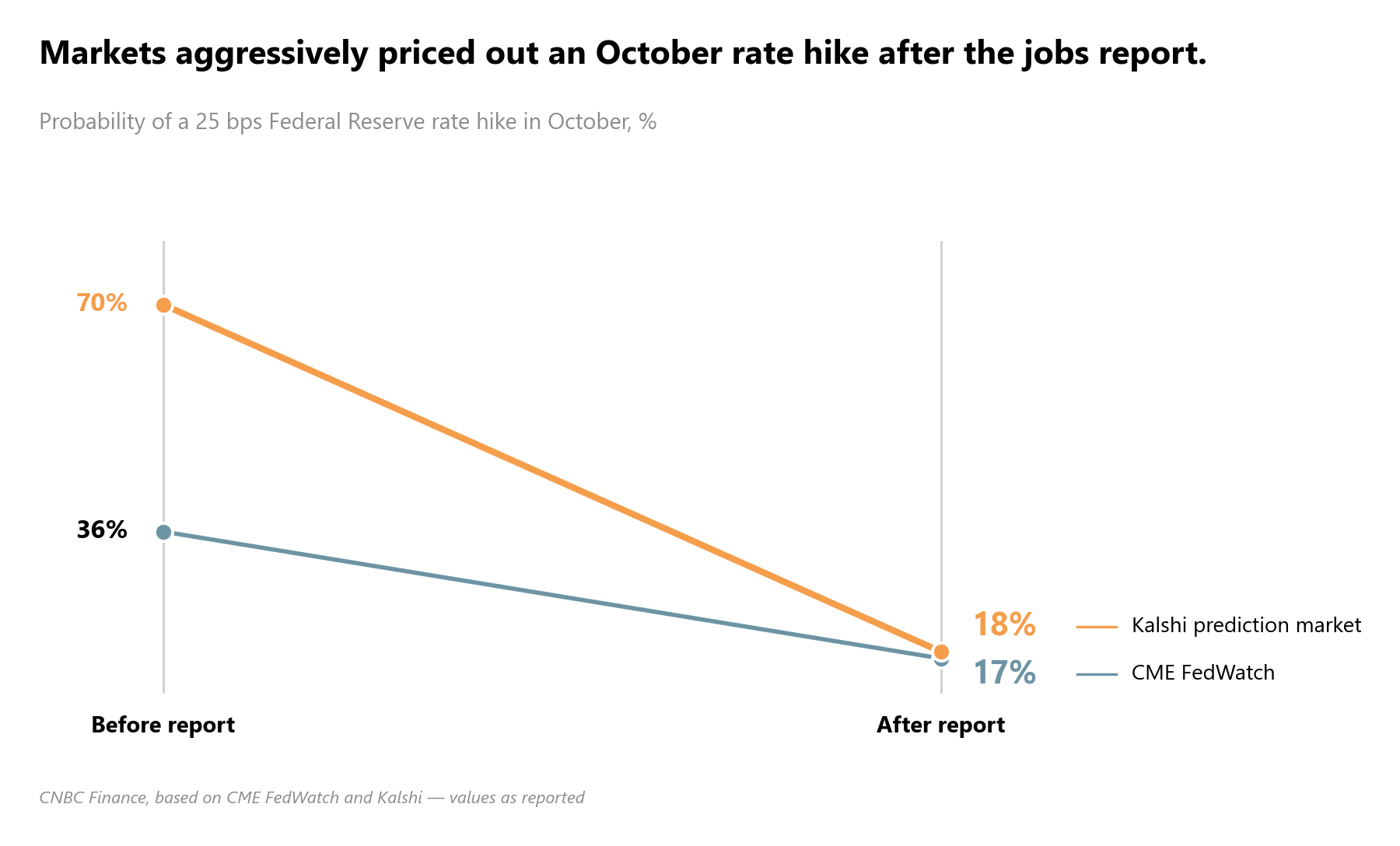
Prediction markets and futures pricing reflected a massive shift in sentiment. The CME FedWatch tool, which tracks trading in interest rate futures, showed the probability of a quarter percentage point rate increase in October plummeting to 17 percent, according to CNBC Finance. Just one week earlier, the odds of a hike stood near 36 percent. The Kalshi prediction platform recorded an even steeper decline, with the chances of an October increase falling to 18 percent from almost 70 percent the previous week.
Adam Schickling, a senior economist at Vanguard, observed that the report strengthens the case for the Federal Reserve to remain patient. He noted that while the labor market has not deteriorated sharply, there is also little evidence that it has meaningfully strengthened, giving policymakers a valid reason to wait for additional data. Consequently, the market consensus shifted away from October, although FedWatch places the odds of a December rate hike above 65 percent, and Kalshi records exactly 65 percent odds.
The Fed’s Pre-Existing Inflation Focus
Federal Reserve officials are looking at a much longer horizon. The central bank raised benchmark rates by a quarter percentage point in September to combat inflation, and key policymakers maintain that price stability remains their primary concern.
The core personal consumption expenditures price index, which excludes volatile food and energy prices, rose 3.0 percent in August, according to CNBC Finance. That figure came in lighter than the 3.3 percent consensus estimate reported by CNBC Finance, but it remains significantly above the Federal Reserve target. Minneapolis Federal Reserve President Neel Kashkari told CNBC during a Council on Foreign Relations event that inflation is still too high. He emphasized that price growth has been elevated for more than five years, and the August data did not change that fundamental story.
Kashkari also pointed to a structural shift in the economy that requires tighter monetary policy. He has raised his estimate for the neutral funds rate to 3.25 percent, arguing that the rate is temporarily elevated due to the massive demand for investment capital surrounding the artificial intelligence boom. Kashkari warned that if this massive corporate investment does not yield tangible productivity gains, the resulting malinvestment could have big economic consequences. The former Treasury Department official noted that the artificial intelligence industry may need to learn to be more efficient with money and resources in an era of tighter monetary policy. The implication is that the central bank cannot afford to lower rates simply because one month of employment data missed expectations, especially when capital is already flowing freely into technology infrastructure. Kashkari acknowledged that interest rate hikes might not slow hyperscalers significantly, but they could have a helpful impact on other areas of the overheating economy.
The impact of persistent inflation is also felt acutely outside of the technology sector and urban centers. Federal Reserve Governor Lisa Cook addressed the dual mandate in a speech focused on rural communities. She noted that inflation has exceeded the 2 percent target for more than five years, profoundly affecting the 20 million workers in rural areas.
Cook explained that transportation costs account for a fourth of all expenses for rural households, compared to less than a fifth for urban households. Housing costs have also surged in these regions. Between March 2020 and March 2023, home values in nonmetro counties, smaller metro areas, and low-density suburbs of large metros rose approximately 36 percent. The influx of remote workers and demand for additional space drove those prices higher, and counties with a high share of vacation and second homes saw home prices rise by 47 percent over the same period. For policymakers like Cook, who voted for the September rate hike, these localized pressures prove that the fight against inflation is far from over.
What it means
The September jobs report exposes a disagreement about the economy’s trajectory. Financial markets are optimizing for the immediate future, treating the 29,000 nonfarm payroll figure as a guarantee that the Federal Reserve will pause its rate hikes in October. Investors see a slowing labor market and conclude that the tightening cycle must halt. This perspective assumes that monetary policy decisions are highly elastic and responsive to single month data anomalies.
The Federal Reserve is operating on a different set of metrics. Central bank officials look at the precise unemployment flows, the steady labor force participation, and the continued strength in private sector hiring recorded by ADP. More importantly, they face an inflation rate that has stubbornly refused to return to its 2 percent target for over half a decade. Policymakers have repeatedly emphasized that bringing inflation down requires sustained effort, and premature relaxation could allow price pressures to become entrenched.
One weak payroll report does not outweigh structural inflation drivers. Artificial intelligence investments demand massive capital, and housing costs continue to pressure rural households. The central bank thus has reasons to maintain its hawkish posture. The gap between market expectations and central bank intent creates a fragile environment for asset prices. If the Federal Reserve proceeds with a rate hike in December, or even surprises markets with action in October, the repricing across equities and bonds could be severe. The underlying data suggests the Federal Reserve is not yet ready to declare victory over inflation.
Sources
- Labor market faltered in September as jobs increased by just 29,000, unemployment rate rose to 4.2% (CNBC Markets)
- Private sector jobs rose by 90,000 in September, better than expected, ADP reports (CNBC Markets)
- Flash Report: Unemployment Rises Slightly, Job Growth Slows in September (St Louis Fed (On the Economy))
- Traders now see little chance of a Fed rate hike in October after weak jobs report (CNBC Finance)
- Fed’s Kashkari says inflation is ‘still too high’ even after softer-than-expected PCE data, labor market is ‘pretty good’ (CNBC Finance)
- Cook, The Dual Mandate in Rural America (Fed Speeches)