AI Agents Shop for Car Insurance. None Is on Record Moving Bank Deposits
On September 18, a review commissioned by the Federal Reserve concluded that social media did not trigger the 2023 run on Silicon Valley Bank, and found no evidence that it accelerated the run. Earlier that month, on September 8, Meta had launched Muse, a personal AI agent that one user says switched his car insurance for him. Read together, the two point to a different exposure from the "agentic bank run" now being discussed: part of what banks earn rests on depositors who rarely move their money, and an agent has no reason to share that habit.
What a checking account is really paying for
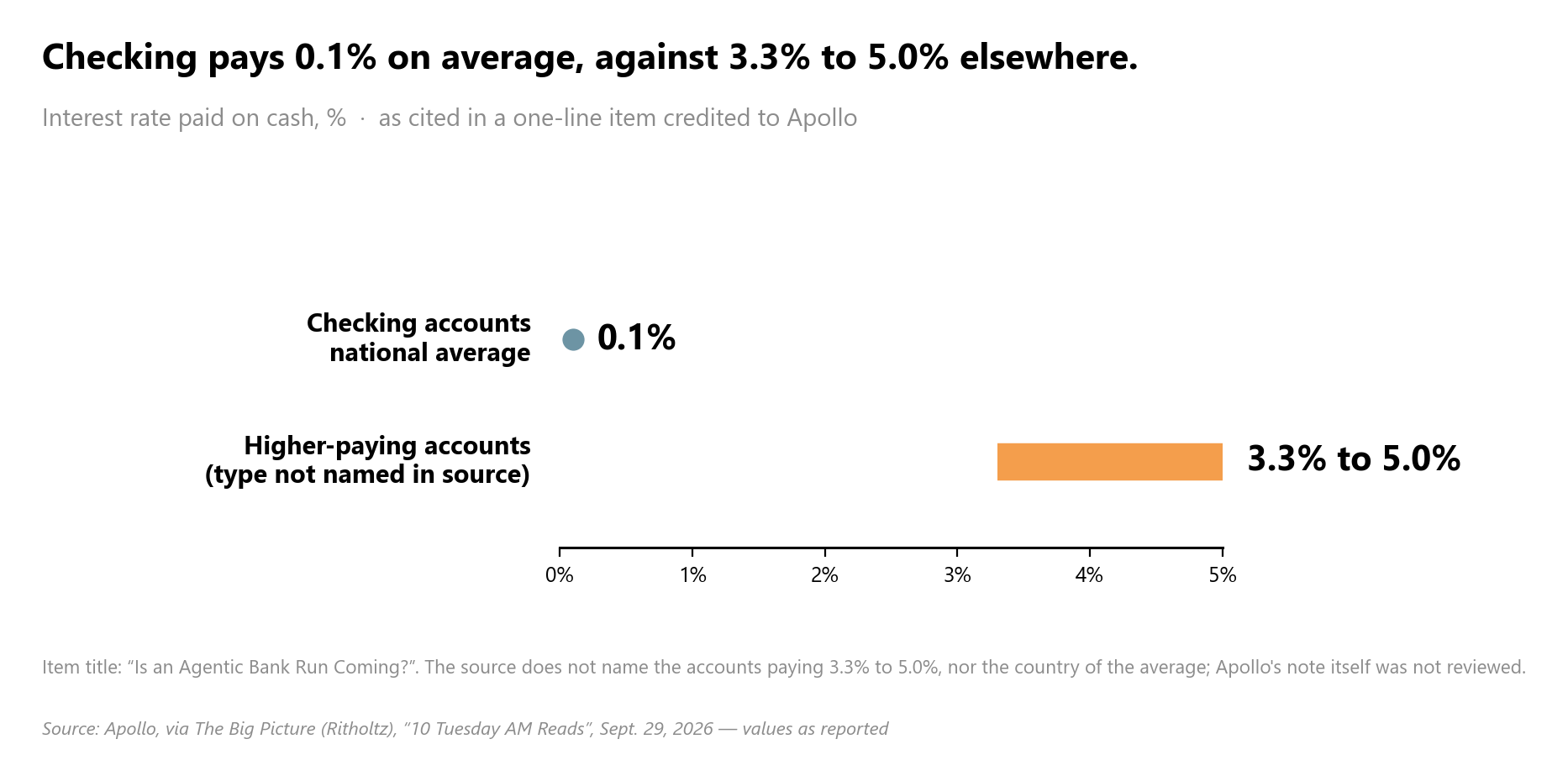
A bank funds itself largely with deposits, pays depositors less than it earns by lending and investing that money, and keeps the spread. On an ordinary checking account, that spread can be wide. An item in Ritholtz’s morning reading list on The Big Picture, credited to Apollo, puts the national average on checking accounts at 0.1%, against accounts paying 3.3% to 5.0%.
The Apollo figures come with caveats, and they belong next to the numbers. Apollo’s note is not among the documents we reviewed. We know it only through one line in a link roundup, which may be Ritholtz’s paraphrase rather than Apollo’s words, and that line does not say which country’s average it is. The item’s title is a question, “Is an Agentic Bank Run Coming?”, and its text is a single sentence: Muse and similar agentic AI assistants “could soon sweep household cash automatically” into the better paying accounts. It says nothing about how fast that would happen.
Taken at face value, a gap between 0.1% and 3.3% to 5.0% should not survive in a market where anyone is free to switch. One reason it survives is that moving money costs something other than money. I had absolutely never looked at the rate on my own checking account until a few years ago, when I started studying finance. The money I once had in an account earned nothing, and I didn’t move it. First, moving it to an account that paid would have meant opening another account and having to manage that, for a sum that wasn’t really worth the trouble. Second, investing it requires following the investment, and even in something with little risk, it becomes money that is “outside”.
Neither of those two frictions, the paperwork of a new account and the attention an investment demands, has anything to do with the rate itself. Both are the kind of chore a software agent is built to take over. Net Interest, a newsletter on the finance industry, noted on September 25 that Muse “promises to take on big audacious goals,” and asked: “Could one of those be to neutralise the inertia on which much of the finance industry’s margin depends?” The part of the post we could read stops at the question. There is a second reason that inertia matters, beyond margins. A bank run is the moment when depositors stop being inert, all at once.
What the SVB review actually found about speed
Silicon Valley Bank is the usual reference for depositors leaving at digital speed. As Michelle Bowman, the Fed’s Vice Chair for Supervision, put it, “many postmortem accounts have asserted that social media fueled the run at SVB.” On September 18, at Mansion House in London, Bowman presented the initial findings of an independent review by Starling Advisory Group. Two facts help in reading it. Bowman herself called for the review in June 2023 and engaged Starling after her confirmation, and the report is “the first in a series”.
Bowman summarized the review in seven findings. The first is that SVB failed as the result of “a confluence of vulnerabilities,” including accounting losses on its securities that were “real but unrealized” and exceeded its capital, and a lack of operational readiness to borrow from the discount window, the Fed’s lending facility for banks, when it was needed. The same finding calls the deposit base “run-prone”: 94 percent uninsured, meaning above the level deposit insurance guarantees, and concentrated in technology companies backed by venture capital. SVB’s depositors were not the inert kind.
The seventh finding addresses speed directly. Bowman said that Charles River Associates analyzed the social media claim at Starling’s request and “concluded that social media did not trigger the bank run at SVB, and there was no evidence that social media accelerated the run.” Among other things, the firm found that “96 percent of the social media chatter regarding the run appeared after SVB’s failure was inevitable.” The wording is careful, and it should stay that way here: “no evidence” of acceleration is a weaker claim than proof that none occurred, and Bowman’s speech does not describe how the analysis was done.
The findings in between concern a different speed, the supervisors’. Fed supervisory staff “knew, or should have known” about SVB’s vulnerabilities “as early as March 2022,” and did not take “prompt and decisive action.” In Bowman’s summary, “one significant factor” behind that inaction was “a long-standing culture of risk aversion”: “Staff believed it was personally safer to take no action unless they were certain the action was exactly right.”
Bowman gave a second speech the same day, on stress testing, and used SVB as her example there too. A plausible recession scenario, she said, “would have shown the firm’s capital falling below minimum required levels as early as the fourth quarter of 2021.” Later in that speech she described risks that “quietly erode” a bank’s financial health, “the kinds of risks that can build over multiple quarters without triggering an alarm.” That passage is about stress tests and bank specific exposures, not about AI. Set next to her SVB example, it describes a weakness a scenario could have shown by late 2021, which the review says supervisors did not act on promptly. That reading is ours.
The agents are here, and so far they switch insurance
Muse launched on September 8, according to a Yahoo Finance report on a Bank of America note. The app can browse websites, organize email and complete multistep tasks with limited user intervention. Two adoption figures circulate, and they measure different things. Net Interest reports 2.8 million downloads within two weeks and the top spot on both Apple’s US App Store and Google Play, without saying where the figure comes from. Bank of America, citing Sensor Tower data, said Muse had passed 2.5 million cumulative US downloads by September 19 and reached about 557,000 daily active users. The Yahoo Finance piece adds its own caveat: “downloads alone will not prove lasting demand.”
What these agents have actually done with money so far is narrower than the headlines. The author of Net Interest has been trialling Instinct, a similar app from the startup Spear Street Technology that runs inside WhatsApp. After his car insurance premium jumped 83% at renewal, he asked it for cheaper cover: “Instinct analysed my current policy, approached carriers for alternative quotes and offered to automate a switch to a cheaper policy, all while I slept.” Net Interest also relays a post from one driver who says Muse saved him $3,500 a year by switching him from Liberty Mutual to Progressive. That is one person’s post, not a measure of typical savings. Net Interest notes that aggregator portals could have done the same job, “but the friction of an AI assistant was lower.”
Angela Strange, a partner at the venture capital firm Andreessen Horowitz, quoted by Net Interest, extends the insurance case to banks herself: “This is what Insurance companies (and banks) should be TERRIFIED about… Inertia and information asymmetry will no longer be enough to keep customers.”
Some brakes are already visible. The Yahoo Finance piece notes that Muse requires access to sensitive personal accounts, which raises privacy and trust concerns, and that Amazon has already blocked the agent from shopping on its platform. Marissa Mayer, the former Yahoo CEO who has just unveiled a rival assistant called Dazzle, pitches it to TechCrunch partly on the security concerns raised by products like Instinct and Muse.
One step is still missing from the record. In the material we reviewed, no agent has moved a bank deposit. The Apollo line says only that Muse and similar assistants “could soon” do it.
An agent has no trust in the system to fall back on
If agents have not yet touched deposits, does the SVB finding at least rule out the fast version of the story? The possibility isn’t zero. The connection makes sense, even if in this case it isn’t proven. The AI factor speeds things up even more, because humans have a certain inertia, a certain trust in the system, but an agent that manages a portfolio doesn’t have all that. It acts. That’s the danger.
Finding seven can be read from that angle. By Bowman’s account, 96 percent of the social media chatter about the run appeared after SVB’s failure was inevitable. What the finding measures is that chatter, in 2023. Nothing in Bowman’s account suggests the review asked what an automated reader of the same posts, acting on them as they appeared, would have done. That question is ours, not the review’s.
An agent’s response to posts like those depends on who set its instructions. What worries me isn’t so much that the agent acts by itself and decides to place money. I think an agent today is capable of following a simple strategy. What worries me is the freedom that would be given to agents to invest money without a strategy, by people who don’t know how to invest. Worse, if an agent doesn’t have defined limits and strategies (which most people can’t do), it is subject to the choices of those who can influence that (financial advisers), or even to the panics and manipulations of the information sources that can influence the agent’s choices.
Limits of that kind have a counterpart in payments. Speaking for himself rather than the Board at the Sibos conference in Miami on September 29, Fed Governor Christopher Waller separated two models of agentic commerce, where AI agents make online purchases. In the “agent assisted” model, the buyer remains in control. In the “agent delegated” model, “The buyer may specify some constraints and set up guardrails, but the agent operates autonomously,” which, Waller said, “requires a more extensive buildout of trust mechanisms and guardrails.” He added that fraud systems “calibrated to human behavior, may not translate well to agents,” and that agentic transactions “could materially change the frequency and timing of payments.”
Waller was talking about shopping and payments. He said nothing about deposits, bank runs or depositor inertia. The overlap is our reading: the constraints and guardrails he describes resemble the limits and strategy that, in the account above, most people cannot set.
What it means
For banks, the best supported effect is the least dramatic one: pressure on what they pay for deposits. That is our inference, joining Apollo’s rate gap to Net Interest’s question. No source we read has measured it yet, and the documented cases of agents at work concern car insurance, not bank accounts.
For supervisors, a deposit base that thins as agents shop for better rates would be the kind of vulnerability that, in Bowman’s account of the Starling review, supervisors knew or should have known about at SVB and did not meet with “prompt and decisive action.” It could also build, in Bowman’s stress testing phrase, “over multiple quarters without triggering an alarm.” Both parallels are our inference.
The friction that, on our reading, protects deposit margins sits with the customer today: the account never opened, the investment never followed. With agents, it would move into the agent’s authorization settings. Waller, speaking about payments, put that trade-off as a question: “What is the right balance between user convenience and purposeful friction in agent authorization?”
That question also lands on individuals. Suppose a friend has installed Muse and is thinking of letting it move his savings on its own to the best paying account, something no agent in our sources has yet done. I would tell him it can be beneficial for him, but I would ask whether he has really looked at the terms that apply, and above all whether he has really defined the limits and the investment strategy.
Three things will show which way this goes:
- Whether agents get into bank accounts at all. Muse is currently only available in the US and Canada, and Amazon has already blocked it from shopping on its platform. Waller, speaking about online retailers, left open whether agentic commerce will run on open systems or on closed ones that block outside agents; whether banks end up in either camp is our question, not his.
- Whether Apollo’s note becomes readable in full, and says more than one line in a reading list can carry.
- The next Starling reports. This one is the first in a series, and Bowman’s speech does not describe Charles River Associates’ method; a later report may.
Sources
- Initial Findings from Independent Review of Silicon Valley Bank (Federal Reserve, Michelle W. Bowman)
- The Final Chapter on Modernizing Bank Regulatory Stress Testing (Federal Reserve, Michelle W. Bowman)
- Payments in the Age of AI Agents (Federal Reserve, Christopher J. Waller)
- Agents Revolt (Net Interest)
- 10 Tuesday AM Reads (The Big Picture)
- Bank of America backs Meta stock after Muse surprise (Yahoo Finance)
- With Dazzle, Marissa Mayer bets your camera roll has more info on your life than your inbox (TechCrunch)