Eurosystem, SEC and Fed Address Different Steps of Tokenized Finance
Between September 17 and 24, the Eurosystem launched a service to settle wholesale tokenized trades in central bank money. The SEC granted a temporary, conditional exemption to venues trading tokenized stocks, and the Fed proposed rules for the payment stablecoin issuers it supervises.

Between September 17 and 24, the Securities and Exchange Commission (SEC), the Eurosystem and the Federal Reserve each published a text about financial assets or money issued as digital tokens. Only the Eurosystem’s has a public authority supplying the money a trade settles in. The two American texts set or propose conditions for private firms, at other steps in the life of a token.
A tokenized trade has several steps, and each one needs someone behind it
Tokenization, as the Eurosystem defines it in a September 21 press release, means issuing or representing an asset as a digital token, typically recorded on a distributed ledger, a database shared across a network. The Eurosystem, which groups the European Central Bank (ECB) and the euro area’s national central banks, adds that the technology can bundle several steps of an asset’s lifecycle, “from issuance and trading to settlement, custody and servicing.” At each step, the question is who supplies what the step runs on and who sets its rules.
Settlement is the step where money changes hands, and a balance is not always what it looks like. My own example is my meal voucher card. It looks like a bank card and I can pay contactless with it, except that the money on it is a bit like fake money, because I can’t spend more than a certain amount per day and I can’t use it where I want. I can also only buy a certain type of item. And after a certain time, that money expires. The difference is getting thinner and thinner.
A meal voucher is a consumer case of a balance defined by its issuer’s rules. In wholesale markets, the concern the Eurosystem reports is risk. During its 2024 tests of central bank money settlement on distributed ledgers, public and private stakeholders indicated that wider adoption of the technology hinged on access to a “risk-free settlement asset.”
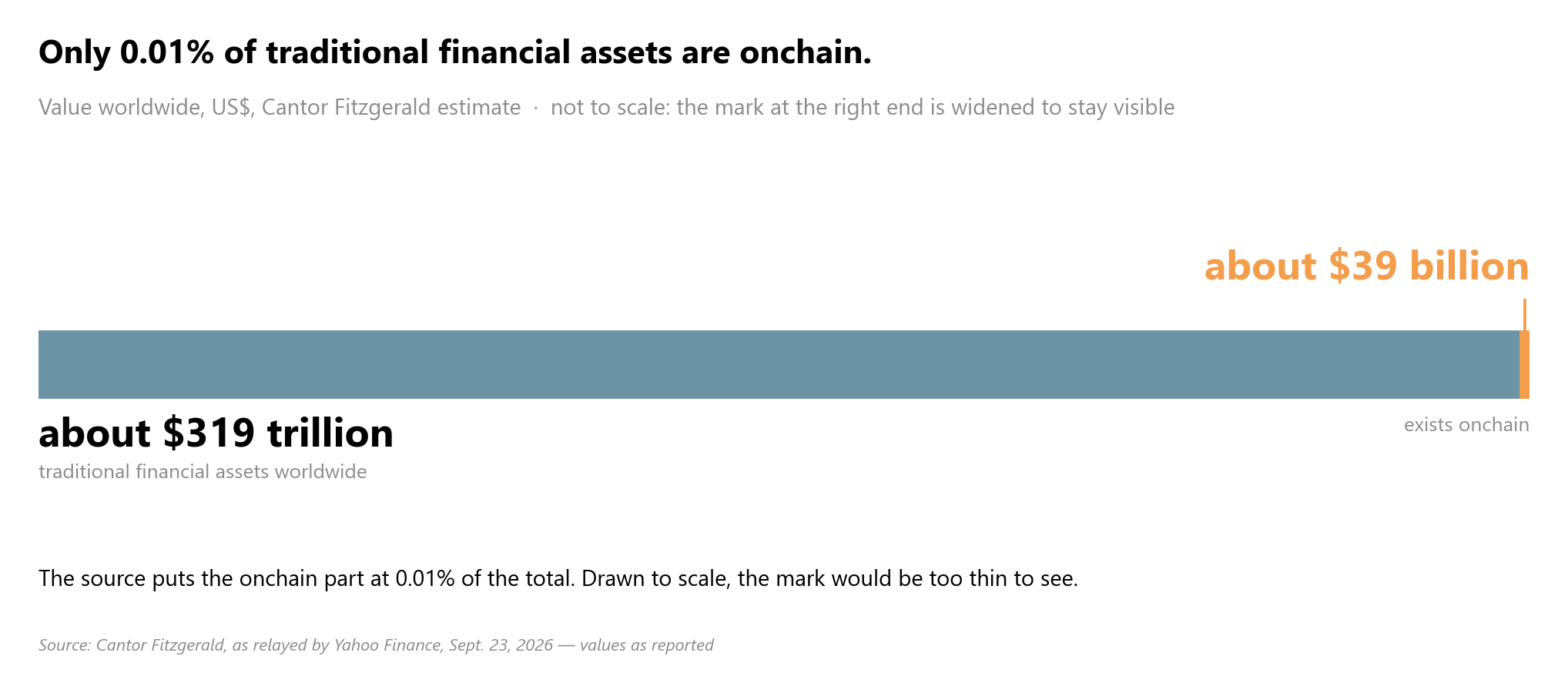
The market such an asset would serve is still small. Cantor Fitzgerald estimates that traditional financial assets are worth about $319 trillion worldwide and that about $39 billion exists onchain, meaning on such a ledger: 0.01% of the total. The estimate comes from a firm recommending a tokenization stock, relayed by Yahoo Finance. CNBC, citing the data provider RWA.xyz, put the combined market value of tokenized assets at $38.51 billion on September 17, a figure of the same order.
At the settlement step, the Eurosystem supplies the money itself
Our earlier article, “In Frankfurt, Cipollone Pairs $354 Billion a Day With His Own Warning,” described Pontes as a Eurosystem project that was not yet running. On September 21, the Eurosystem launched Pontes, which enables wholesale transactions in tokenized assets, those between financial institutions, to be settled in central bank money. Central bank money is a claim on the central bank itself, where an ordinary deposit is a claim on a commercial bank.
Pontes starts with a core set of services, and the Eurosystem expects full implementation, with enhanced features and longer operating hours, by 2028. Piero Cipollone, a member of the ECB’s Executive Board, said of Europe’s tokenized finance ecosystem that Pontes “will give an important advantage to help it scale.”
An initial group of institutions has completed onboarding and can use Pontes immediately. A footnote to the release names market participants, among them Deutsche Bank, Santander, Société Générale and the European Investment Bank, and four operators of distributed ledgers: Axiology, Cashlink, Clearstream and SWIAT.
The footnote lists those four as “Market DLT operators,” that is, market firms operating distributed ledger technology. By that listing, the Eurosystem supplies the settlement asset, not the platform.
A second release the same day concerns the ECB as an investor. The ECB “has launched preparatory work to invest a small portion of its own funds in tokenised securities.” The release announces preparation, not purchases, and the own funds portfolio sits outside monetary policy. Initial investments will focus on euro-denominated securities issued by euro area central and regional governments, agencies and European supranational institutions, with purchases settled in central bank money via Pontes. The ECB’s Executive Board will set the timing once the preparatory work is complete.
At the trading and issuance steps, the SEC sets terms for private firms and the Fed proposes them
At the settlement step, a public authority supplies the asset itself. The two American texts address other steps, and the first is trading. On September 17, the SEC issued an order granting “temporary, conditional” exemptive relief from the definition of “exchange” in the Securities Exchange Act of 1934 to a category it calls Tokenized Securities Venues, or TSVs. The relief covers one asset class, tokenized National Market System stock. CNBC describes the same order as covering tokenized publicly traded US stocks, and Jamie Selway, director of the SEC’s Division of Trading and Markets, describes the activity as secondary trading.
A TSV brings buyers and sellers together through liquidity pools open to permissioned participants. The exemption carries conditions. Tokenized stocks on a TSV are subject to limits on the number of symbols and on volume, which the press release does not quantify. A TSV must also verify that the token gives holders the same rights and privileges as traditional stock of an equivalent class. The relief is set to expire five years after publication, and the order asks for public comment. CNBC notes that the order is “not a formal regulation change,” and SEC Chairman Paul Atkins called it an “important first step.”
The Federal Reserve’s text concerns the issuance of a payment token. On September 24, the Federal Reserve Board requested public comment on two proposals for a regulatory framework, under the GENIUS Act, covering the payment stablecoin issuers the Board supervises. A stablecoin is a token designed to hold a fixed value against a currency. The first proposal would require those issuers to fully back their stablecoins with permissible reserve assets, “such as short-term Treasury bills” and certain other high-quality, liquid assets. The second would create an application process for Board-supervised banks that want to issue payment stablecoins. The comment period closes 60 days after publication in the Federal Register.
Take a friend who cites that proposed reserve rule as his reason to keep part of his money in a stablecoin instead of at the bank. I would tell him that this money is no longer money, it is Treasury bills in disguise, and that he is in reality financing the debt of the country, which he is already financing through his taxes. So I would tell him to find a bank that gives him the real value of his money, taking inflation into account. I would tell him that if he is worried about the value of his money, gold is a safe bet, and that he can think about putting part of his money there. I would also tell him that these stablecoins are the first gear of a machine that will give the government even more control over our lives.
The Fed’s release covers a payment token and its reserves, the SEC’s a trading venue and a stock token. Neither addresses the cash leg of a trade on a TSV, the asset the buyer pays with.
One listed stock moved on the day of the SEC order
On September 17, shares of Securitize were last up 14% in CNBC’s report, after peaking at 24%. The rise followed the SEC’s announcement, and the SEC release itself names no company. Securitize began trading on the New York Stock Exchange on July 2, and Yahoo Finance calls it the first tokenization company to go public. Cantor Fitzgerald initiated coverage of Securitize on September 21 with an Overweight rating and a $21.20 price target.
Securitize is one of the players in tokens. As I see it, the different players in tokens are taking a bigger and bigger place, because the token is now in the sights of governments that aim to implement a digital currency. They are becoming real competitors to the banks. In that sense, their growth potential is multiplied many times over.
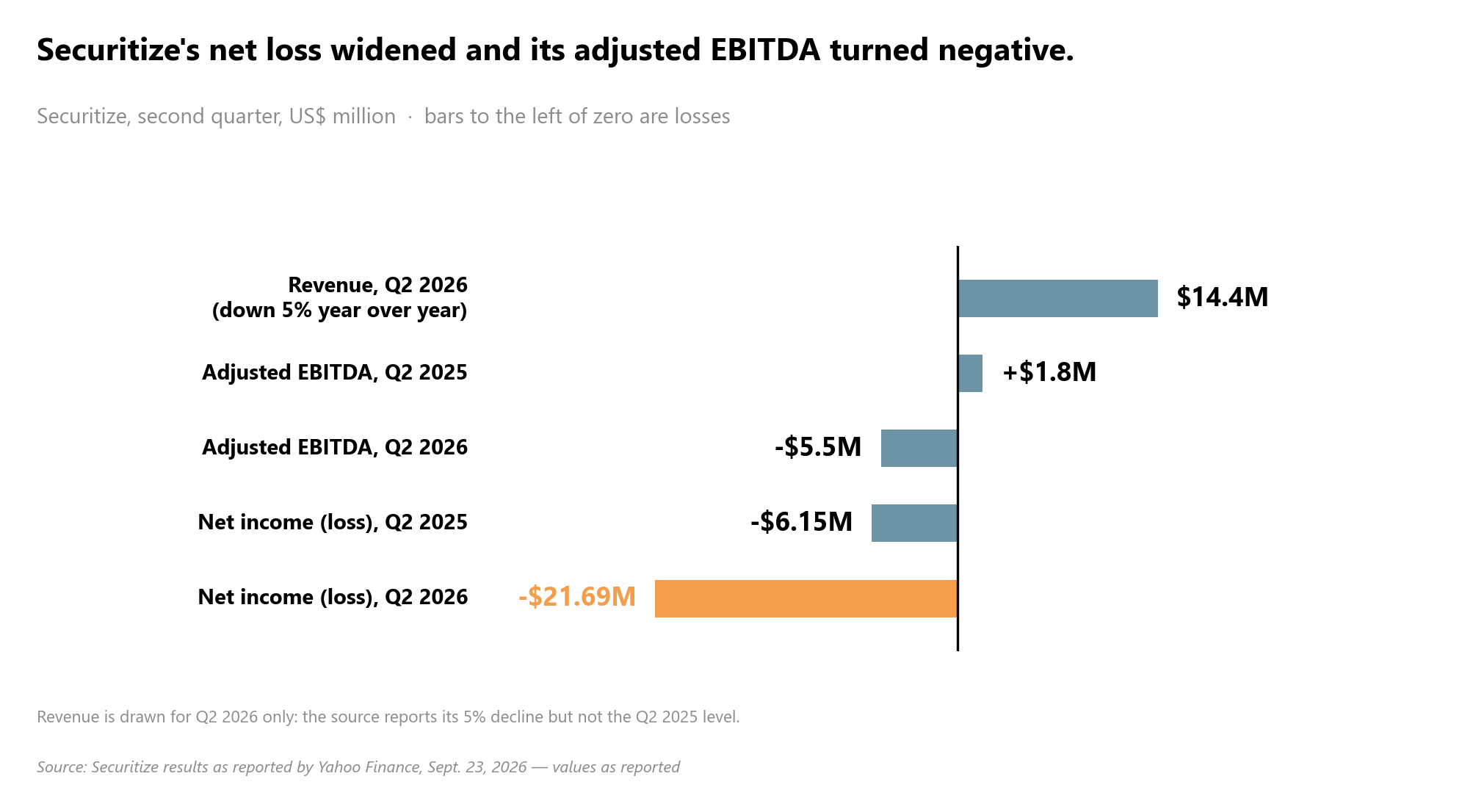
Securitize’s results for the second quarter of 2026, as reported by Yahoo Finance, show growth in assets without growth in revenue. Average tokenized assets under management rose 16% year over year, while revenue fell 5% to $14.4 million. The net loss widened to $21.69 million from $6.15 million, and adjusted EBITDA, a measure of operating profit, turned from a positive $1.8 million to a loss of $5.5 million.
The banks those players would compete with are inside the official texts too. The Fed’s second proposal is written for Board-supervised banks that want to issue payment stablecoins, and the Eurosystem’s release has banks and market infrastructures joining Pontes in a gradual approach.
What it means
Taken together, the three texts show public authorities in two roles. At settlement, the Eurosystem supplies the asset, and its release lists market firms as the ledger operators. At trading and at the issuance of a payment token, the SEC has set, and the Fed has proposed, conditions for private firms. The texts address different steps. Placed side by side, they show a division of roles, not a public model against a private one.
The three texts also differ in kind. Pontes is a launched service with full implementation expected by 2028, the SEC’s relief expires five years after publication, and the Fed’s two proposals are open to comment until 60 days after their publication.
What a public against private reading misses, for me, is that a well-defined currency is not a currency alone but a whole system of governance and incentives, of regulations. The dollar is free and is the universal currency, yet it rests on the trust we have in the institutions that control it. The Chinese yuan, from the international point of view, seems to be a less good currency because it is under the direct control of the Chinese government, so the element of trust is absent.
Read as systems of governance, the three texts each describe the institutions behind a digital form of value: a central bank for the money settled through Pontes, a supervisor and a proposed reserve rule for a payment stablecoin, a regulator’s conditions for a tokenized stock.
What to watch next:
- The publication dates of the SEC order and of the Fed proposals, which start the five-year and 60-day periods.
- The size of the symbol and volume limits, and the first venue that seeks to operate as a TSV.
- The ECB Executive Board’s decision on the timing of its investments.
- Appia, under which the Eurosystem, Danmarks Nationalbank and stakeholders from the public and private sectors aim to deliver a blueprint for an integrated tokenized ecosystem by 2028.
Sources
- SEC Issues “Innovation Exemption” to Facilitate the Trading of Tokenized NMS Stock and Request for Comment (SEC)
- Federal Reserve Board requests public comment on two proposals related to establishing a regulatory framework for Board-supervised payment stablecoin issuers under the GENIUS Act (Federal Reserve)
- Eurosystem brings central bank money to tokenised finance (European Central Bank)
- ECB to invest part of own funds in tokenised securities, with settlement via Pontes (European Central Bank)
- Securitize jumps after regulators greenlight some tokenized U.S. stock trading (CNBC)
- Cantor Fitzgerald Sees Big Upside in Securitize (SECZ): Is It Time to Buy? (Yahoo Finance)
- In Frankfurt, Cipollone Pairs $354 Billion a Day With His Own Warning (Count2Three)