In Frankfurt, Cipollone Pairs $354 Billion a Day With His Own Warning
While private tokenized repo settlement reaches $354 billion a day, European Central Bank officials warn that the safe, elastic settlement asset this market requires does not yet exist on-chain.
A private platform in the United States now settles an average of $354 billion a day in tokenized repo trades, four times what it handled a year earlier. Piero Cipollone, a member of the European Central Bank’s Executive Board, cites that figure as proof that tokenization has moved from experiment to operating scale. Two days after he said so, his ECB colleague Isabel Schnabel told the Jackson Hole symposium that the asset this market actually needs to settle safely does not yet exist outside a central bank.
What a Settlement Asset Has to Be
Schnabel’s argument rests on a distinction that sounds narrow until it is tested against history. A settlement asset, she told the symposium, has to satisfy two conditions: safety, meaning free of credit, liquidity, and redemption risk, and elasticity, meaning its supply can expand when demand for liquidity spikes, especially under stress.
The United States tried running a monetary system without that elasticity for decades. During the free banking era, state chartered banks issued their own notes, and those notes traded at a discount whenever the issuing bank was distant or distrusted. The National Banking System that followed tied the money supply to banks’ holdings of eligible government bonds, so liquidity could not expand to meet a sudden surge in demand for cash. That rigidity fed the banking panic of 1907 and led Congress, six years later, to create an institution whose reserves could expand when private money could not.
A stablecoin, even one backed one for one by Treasury securities, inherits the same limitation as a note issued by a distant bank. It can be made almost perfectly safe. It cannot expand its own supply when funding markets seize up, because that requires an issuer able to create liquidity on demand when everyone wants it at once. Only a central bank has that capacity. Schnabel put the state of play plainly at the start of her remarks: the takeoff of tokenized finance, she said, has so far partly been held back by the lack of a safe settlement asset.
The Number Offered as Proof
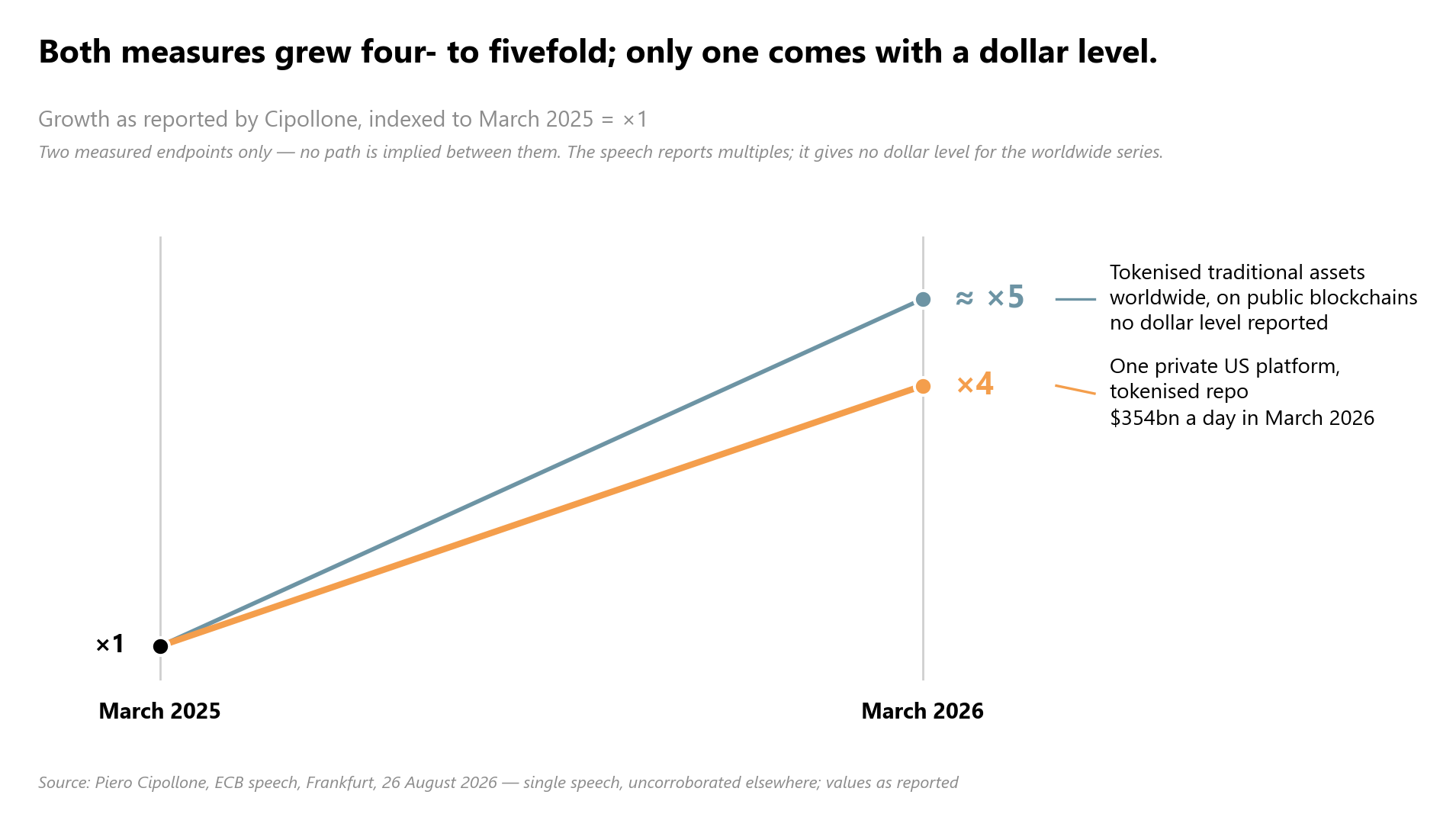
Cipollone made no such qualification two days earlier, in Frankfurt. In a speech at the Bundesbank’s payments symposium on August 26, he described tokenization as a market already moving, not a promise waiting on its foundation. Worldwide, he said, tokenized traditional assets recorded on public blockchains increased roughly fivefold between March 2025 and March 2026. In the United States, one private platform processed an average of $354 billion in tokenized repo transactions per day in March 2026, four times the average daily volume it recorded a year earlier.
Both figures come from that single speech, and the platform itself goes unnamed in it. No other source in this reporting corroborates either number independently. Cipollone’s own reading of the number is unambiguous. While still small, he said, the figures point to genuine momentum. In some segments, he added, activity has already reached meaningful operational scale, repo among them.
Scale tells you a market is real. It does not close the settlement gap Schnabel just described.
Running the Number Through Schnabel’s Test
Cipollone had already named that gap himself, in the same Frankfurt speech, before Schnabel spent her Jackson Hole remarks explaining why it matters. Tokenized markets, he warned, face the loss of the monetary anchor. Without access to central bank money, he said, they could become reliant on private settlement assets which carry credit and liquidity risks and do not have the same ability to scale elastically.
Cipollone’s own verb there is conditional, not descriptive. Markets could become reliant on private settlement assets, he said; he did not say that they already are. Neither his speech nor Schnabel’s says what actually settles the trades behind the $354 billion figure, and this article does not claim to know. What both speeches state plainly, on the record, is that the safe settlement asset tokenized finance needs is not yet in place at the scale the market has already reached. Schnabel made the same point from the policy side: a prerequisite for unlocking the benefits of tokenization, she said, is the availability of a trusted settlement asset within a tokenized environment.
The only American initiative either speech names is Project Pine, a joint research study by the New York Fed and the Bank for International Settlements’ Innovation Hub. Schnabel cites it to show that smart contracts could make monetary policy operations run natively on a ledger. It is a study, not a live settlement service, and neither ECB speaker treats it as one.
So the market Cipollone cites as proof that tokenization has arrived is, by the ECB’s own account, running ahead of the infrastructure the ECB says it needs. Cipollone named that exact gap as his second risk. His third risk follows directly from it: dependence on infrastructure Europe does not control.
Dependence, Seen Twice
External dependence is the phrase Cipollone used for that third risk. Europe, he warned, could become reliant on infrastructures, technologies, governance arrangements, or settlement assets controlled outside Europe.
A different market shows the same shape of concern, even though the mechanism is not identical. Reserve managers, not settlement rails, are the subject this time. Linda Goldberg, Oliver Hannaoui, and Sneha Parthasarathy, researchers at the Federal Reserve Bank of New York, found that the dollar’s share of global official foreign exchange reserves fell from 64 percent in 2015 to 56 percent in 2025. The decline looks broad until it is decomposed. Looking just at the preferences channel, which captures countries actively reallocating away from the dollar, the researchers find that China and Russia accounted for most of its 1.2 percentage point contribution to the 2.8 point drop recorded between 2015 and 2019. The other channel, over that same period, was reserve accumulation at below average dollar shares, and it was dominated instead by Switzerland. China’s own contribution to that second channel was positive, the opposite direction from its contribution to the first. Reserve concentration and settlement infrastructure are different problems, but they share the same structure: dependence, where it exists, sits with a small number of actors who set terms nobody else voted on.
The ECB’s response to that structure is not confined to wholesale markets. Cipollone, in an interview published two days before his Frankfurt speech, described the digital euro in the same terms. It would complement cash rather than replace it, work offline so transaction details stay between payer and payee, and prevent the Eurosystem itself from identifying who is paying whom online, a protection ordinary bank transfers do not offer. Pontes and Appia answer the wholesale version of external dependence. The digital euro answers the retail version. Both put the ECB in the business of building its own rails rather than trusting someone else’s.
What It Means
None of those rails are running yet, and the dates attached to them are targets, not track records. Pontes, the Eurosystem’s project to settle DLT transactions in central bank money, launches next month, according to Schnabel’s Jackson Hole remarks. Cipollone, in his own Frankfurt speech, said the initial rollout will carry only a one-time onboarding fee, with no recurring charges. A 24/7 version, with greater programmability, is targeted for mid-2028, the same speech says. Appia, the companion project defining standards and legal architecture for a unified European market, aims for a blueprint the same year.
Elsewhere, the race looks similar. South Korea’s Project Hangang has tested a unified ledger under central bank leadership, though moving tokenized securities onto that same platform is still at the proof of concept stage. The Bank of Canada’s Project Samara has shown that issuing and settling tokenized securities on a ledger can compress a multi-day process into near instant execution. Every one of these is a project or a pilot, not a production system.
What ties them together is the admission built into Schnabel’s opening line at Jackson Hole: the safe settlement asset tokenized finance needs is not there yet, and the market is not waiting for it. The number that proves the market is real is the same number that explains why central banks are in a hurry. Whether their rails arrive before habit settles the question by default, in favor of whatever platform already happens to be processing the volume, is what to watch through 2028.