McKinsey Published a 6% Base Rate and a 20% Promise in 4 Days
In late August 2026, McKinsey published a survey showing enterprise AI high performers stuck at 6%, followed days later by a study promising a 20% EBITDA lift based on twenty selected winners.
Over four days at the end of August 2026, McKinsey published a survey showing that the share of companies getting a significant financial return from AI has not moved in a year, then two more pieces built on twenty handpicked companies, promising a 20 percent EBITDA lift and three dollars of profit for every dollar invested. The second number is the one that keeps circulating. The first rarely travels with it.
What “AI high performer” actually means, and why the definition is doing the work
McKinsey’s State of AI in 2026 survey, fielded online from May 4 to June 8, 2026, with 1,719 respondents across 97 countries and weighted by each country’s share of global GDP, reserves the label “AI high performer” for a narrow group. A company qualifies only if it clears two bars at once: it attributes at least 5 percent of EBIT to AI, and it describes that impact as significant. That double threshold is why the resulting number is small, and why it holds still year over year.
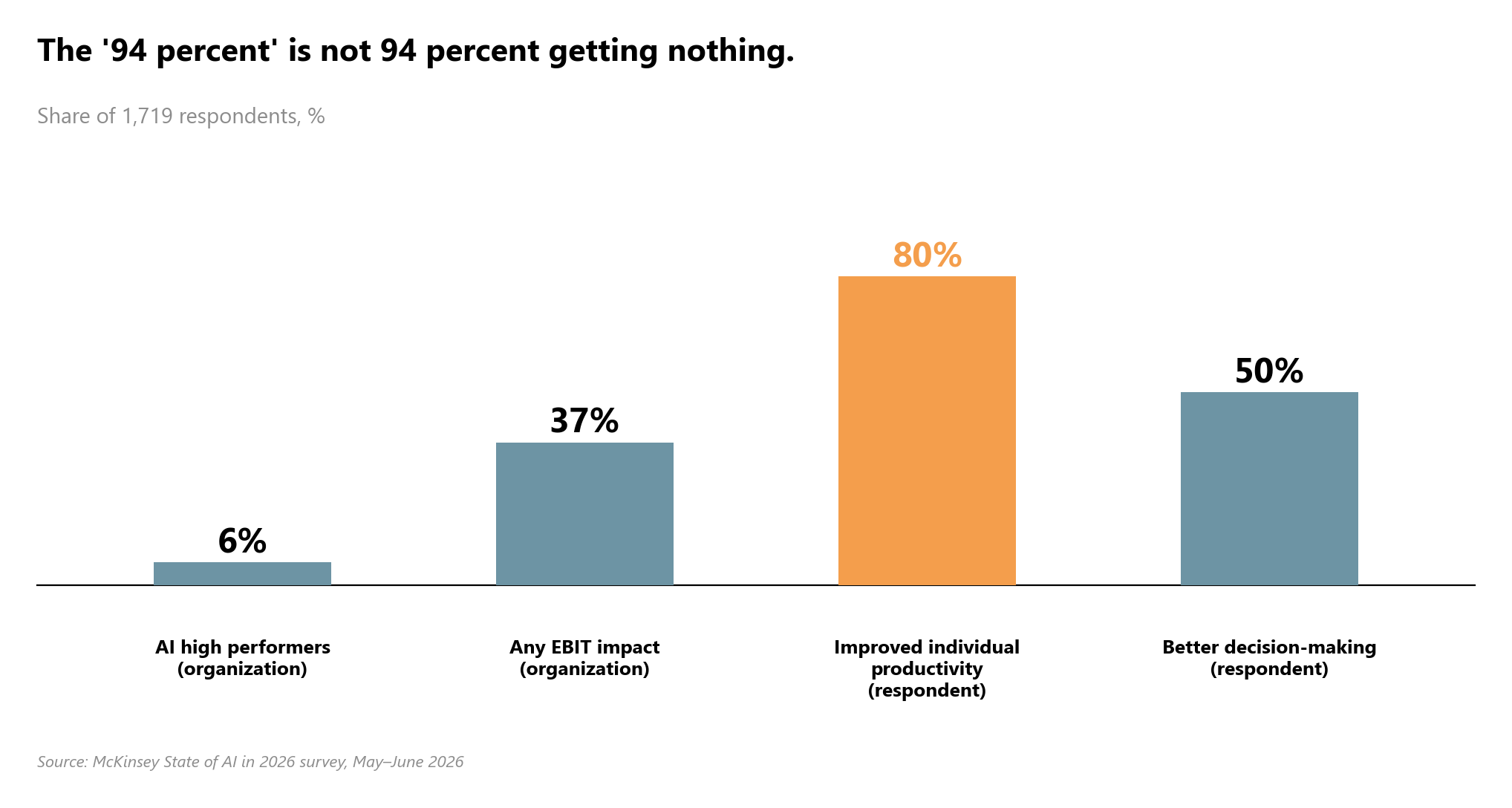
By that definition, 6 percent of respondents qualify as AI high performers, unchanged from 2025. Thirty-seven percent report any EBIT impact from AI at all, also essentially flat versus last year.
Deployment, meanwhile, moved a great deal over the same twelve months. Forty-four percent of organizations now report AI scaling across the enterprise, up from 38 percent. Fifty-six percent use AI in three or more functions, up from 51 percent. Among large organizations, 40 percent report scaling AI agents, up from 27 percent, while adoption among smaller organizations stayed flat at 22 percent. The practice most correlated with high performance intensified too: nearly three-quarters of high performers say they have fundamentally redesigned their workflows because of AI, up from 55 percent a year ago, compared with just one-quarter of everyone else.
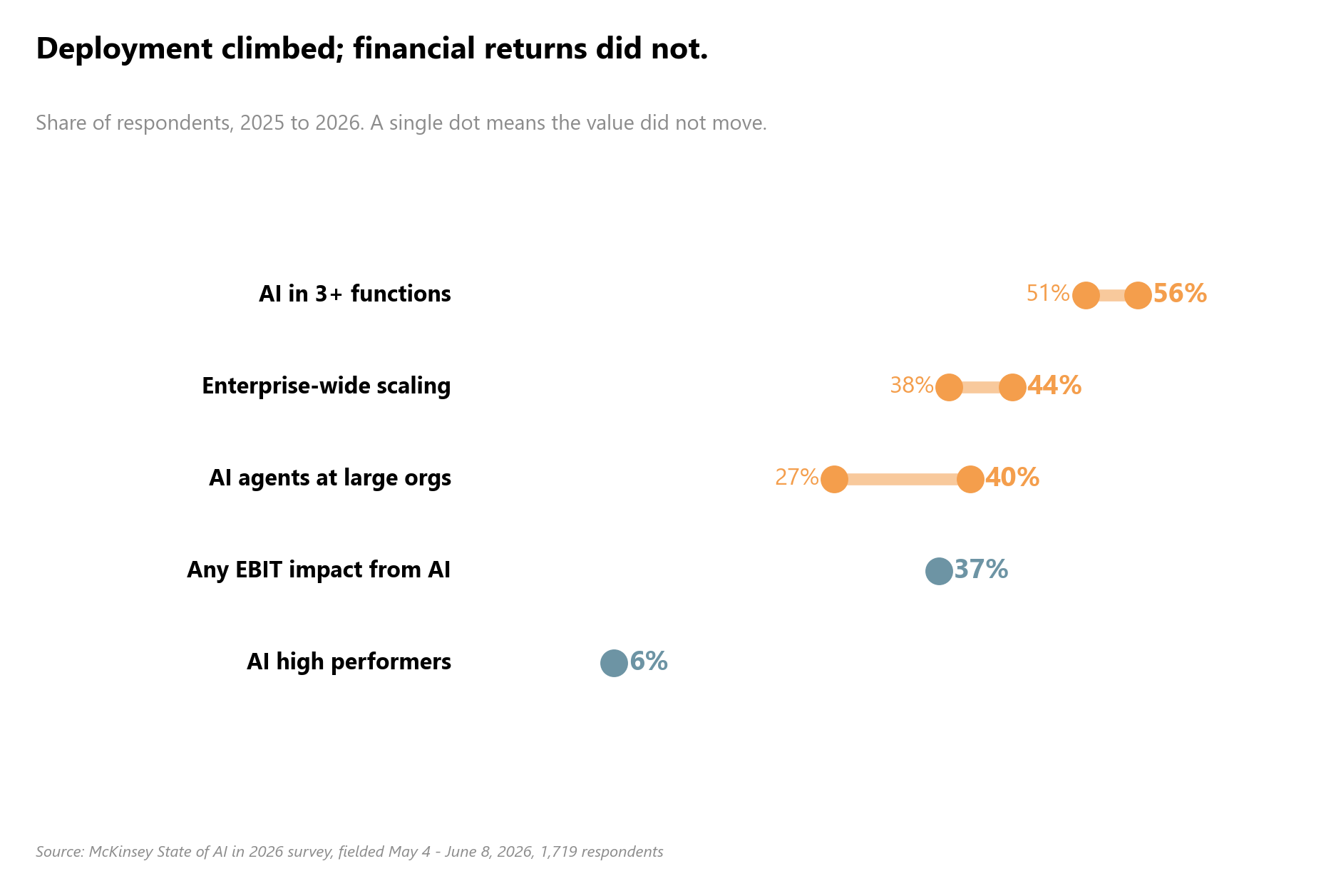
That is the arithmetic underneath everything that follows. A year in which deployment climbed on every measure McKinsey tracks, sitting on top of a circle of financial winners that did not grow by a single point.
Four days later, the same firm publishes what the winners look like
McKinsey published that flagship survey on August 25, 2026. The very next day, it published “The Decision Dividend: How AI Creates Economic Value,” which poses almost exactly the question a careful reader of the survey would ask: why do most organizations still report little or no measurable impact on earnings? Two sentences later, McKinsey answers. Companies that redesign end-to-end workflows around AI, rather than layering copilots and chatbots onto what already exists, often achieve roughly a 20 percent EBITDA uplift, three dollars of profit for every dollar invested, and a payback period of one to two years. No sample size and no company name appear in that piece.
Two days after that, on August 28, “The New Management Playbook for AI: How to Move Faster and Create More Value” reveals where the triplet comes from. McKinsey studied 20 companies that have “consistently created significant economic value” from AI-enabled transformation, selected precisely because they had. The numbers return with more detail attached: EBITDA improved by 20 percent on average over three years, three dollars of incremental EBITDA per dollar invested, cash accretive within one to two years, typical investment between $50 million and more than $200 million. This same article opens by citing the flagship survey directly: “our most recent State of AI report reveals that 94 percent of businesses have yet to create meaningful value.” McKinsey places its own complement to the 6 percent right beside its own promise.
The triplet needs to be read for what it is. It is not a survey result. It is a McKinsey analysis of twenty client engagements, built on transformation road maps and executive interviews, and it should be attributed that way rather than cited as if it came from a poll. Worth noting for context, not as an accusation: the playbook piece accompanied the release of the second edition of McKinsey’s own book, Rewired.
One nuance matters here and should not get lost. The twenty companies in the playbook and the 6 percent of high performers in the survey are not literally the same sample. One is a case study built on named companies; the other is an anonymous survey of 1,719 respondents. What connects them is that both are studying the same category, companies that got significant value from AI, examined by the same firm inside the same four-day window. That is different from claiming they are statistically the same population, and no source makes that claim.
The evidence behind the promise is older than the AI boom it’s sold on
The playbook names its evidence, and the dates matter. Freeport-McMoRan had its first large-scale AI breakthrough in 2018, on its copper concentrators, then repeated the feat three years later on leaching. DBS Bank cut its AI model deployment time from 15 to 18 months in 2018 down to two to three months by 2023, unlocking more than one billion Singapore dollars, about $772 million, in value. LATAM Airlines and Toyota round out the four companies McKinsey names in detail, running forecasting machine learning and agentic workflows that support human planners rather than autonomous systems acting on their own. The playbook concedes as much itself: these four exemplars have been at this for more than five years, and its own capability-maturity table places them as having largely mastered stage two and actively developing stage three, the “agentic AI enterprise.” By McKinsey’s own account, the companies it profiles have not yet reached the stage its own scale calls agentic.
A second, independent McKinsey survey, of 334 product and engineering leaders fielded in the second quarter of 2026, finds the same U-shaped distribution on the terrain most favorable to AI. Only 25 percent of director-level and above respondents report meaningful acceleration, defined as more than a quarter of their teams reaching twofold productivity gains or better. Thirty percent report that productivity actually fell. The gap replays at the individual level: about 80 percent of engineers see an average AI productivity gain of roughly 3 percent, while the top 20 percent average 55 percent. It is the same shape as the 6 percent against the rest, measured by a different survey of a different population, from the same firm.
The number to handle with care here is the $0.8 trillion opportunity this piece derives from the 3 percent to 55 percent gap. It is not a measured amount. It is that gap multiplied by a figure of roughly 30 million engineers worldwide, which the piece footnotes without naming a source in the text it published, and an assumed $85,000 in fully loaded cost per engineer. Treat it as a demonstration of the pattern running through this entire body of work: the same page that records 30 percent of its respondents reporting their teams got slower goes on to price the opportunity by assuming everyone catches up to the top quintile. It is not a number to remember.
The honest counterweight, and the part nobody else is measuring
Three things are worth holding together here. First, a fact that argues against a purely cynical reading. A firm publishing only its sales pitch would not also publish its own flat 6 percent, or case studies that concede their own preconditions, five years of work, only stage two mastered. That is verifiable without leaving the publisher’s own output.
Second, the most honest internal voice in this body of work belongs to Kate Smaje, McKinsey’s global leader of technology and AI and a coauthor of Rewired. In an interview, she sells none of the figures above. She says the technology is the easy part, and that when she watches the teams working most intensively with AI, their cognitive load is rising rather than falling, because routine tasks disappear while what remains demands more judgment, not less. That is a qualitative, named observation from an interview transcript, with no data or exhibit behind it, and it should never be presented as a measured result.
Third, vendor telemetry, which measures the other end of the pipe. OpenAI reports that companies in the top decile of AI usage now generate 8.3 times as many output tokens per active user as typical companies, up from 2.6 times in January. Microsoft reports that more than 80 percent of Fortune 500 companies already have active AI agents in production, built with low-code or no-code tools. Neither figure measures financial outcomes. Both are usage indicators. The point is that deployment climbed on every measure available while the financial result McKinsey itself measures, that flat 37 percent EBIT impact, did not move. The two camps are never measuring the same end of the pipe.
What it means
When an enterprise AI return figure circulates, ask what population it was calculated on, and whether the base rate that should accompany it has been published anywhere by the same source. Treat a study of twenty model companies as an illustration of what is possible for organizations that have already made AI work, never as a forecast for the median company.
The test that settles this for good is not in this body of work. It is next year’s survey. If the share of high performers finally moves after three flat years, the thesis of a lag fades. If it holds at 6 percent a third time while a new sales triplet circulates alongside it, the asymmetric circulation documented here stops being a snapshot and starts being a pattern.
Sources
- The state of AI in 2026: On the road to ROI (McKinsey Insights)
- The decision dividend: How AI creates economic value (McKinsey Insights)
- The new management playbook for AI: How to move faster and create more value (McKinsey Insights)
- Beyond the copilot: Scaling the agentic product development life cycle (McKinsey Insights)
- Your AI agents need performance management, too (McKinsey Insights)
- How AI-native companies turn workflows into operating capability (OpenAI News)
- 5 signals of trusted AI: How organizations scale AI with security, governance, and observability (Microsoft AI Blog)