SEC and CFTC Filings Both Go Live Before Anyone Verifies Them
Two public registries revealed that regulatory filings go live on the applicant's word alone, allowing false entries and unverified event contracts to operate before official scrutiny begins.

Two public registries turned out this year to run on the applicant’s word alone, with no check before the entry goes live. In one, the correction arrived as 38 lawsuits and a quiet removal of listings from a government website. In the other, it took a federal appeals court twenty months to say an entry should never have gone live at all. In both cases, someone was already exposed before anyone official looked.
The blank check both registries hand out
An exempt reporting adviser files a Form ADV with the Securities and Exchange Commission, and the filing becomes a public record without anyone at the Commission verifying what it says. That absence of upfront review shows up in the SEC’s own case against 38 entities: Commission counsel only asked the defendants to substantiate their forms after the forms were already filed and sitting on the SEC’s website, and the defendants did not answer. A parallel structure governs Kalshi’s side of this story. A designated contract market registered with the Commodity Futures Trading Commission can list a new type of contract by filing a written certification that the contract complies with the Commodity Exchange Act, and once that certification is filed, the exchange can begin trading the contract the next business day, under 17 C.F.R. §40.2(a)(2). The CFTC can review a listed contract afterward and disallow it, but only afterward. Neither system asks a regulator to look at the thing before it goes live. Both ask the regulator to notice, later, that something was wrong.
What the paper trail bought before anyone checked
On August 27, 2026, the SEC filed 38 separate complaints in the U.S. District Court for the District of Colorado, alleging the named entities misrepresented themselves in Forms ADV filed between 2025 and 2026 to appear as legitimate advisory firms, in violation of Sections 204(a) and 207 of the Investment Advisers Act of 1940. According to the complaints, the defendants listed Colorado addresses where they had no presence, gave disconnected phone numbers, and claimed audits by accounting firms absent from any public registry. Some connected to the Commission’s own filing system from IP addresses traced to foreign jurisdictions, and several ran websites displaying what the SEC calls a fake certificate of SEC registration. Among the names charged, a few read like an exercise in borrowed credibility: Robin Markets Inc, Web3 University, two near-identical filers named Nova Academy of Finance Ltd and Nova Financial Academy Ltd, and LinkedIn Research Institute Ltd, a name that echoes an existing brand without the SEC alleging the real company was impersonated.
The following Monday, Financial Stability Board chair Andrew Bailey warned G20 finance ministers that frontier AI models’ growing autonomy could materially change the speed, scale and economics of cyber risk. That is a real concern about the future. The fraud the SEC describes did not need it. A fabricated address, a disconnected phone and a stock image of a certificate were enough to pass a registry never built to check any of it before publication. The fraud these filings describe ran on paperwork, not computation.
The correction came after the exposure had already happened. The SEC’s Office of Investor Education and Assistance has issued an alert warning that scammers use exempt reporting adviser filings to create a false impression of legitimacy, and the Commission has removed the 38 entities’ filings from its website. Both steps followed the complaints, not the other way around, with help from the FBI’s Operation Level Up. Everything in this section remains an allegation, not a court finding.
What the same forms didn’t catch in a real firm
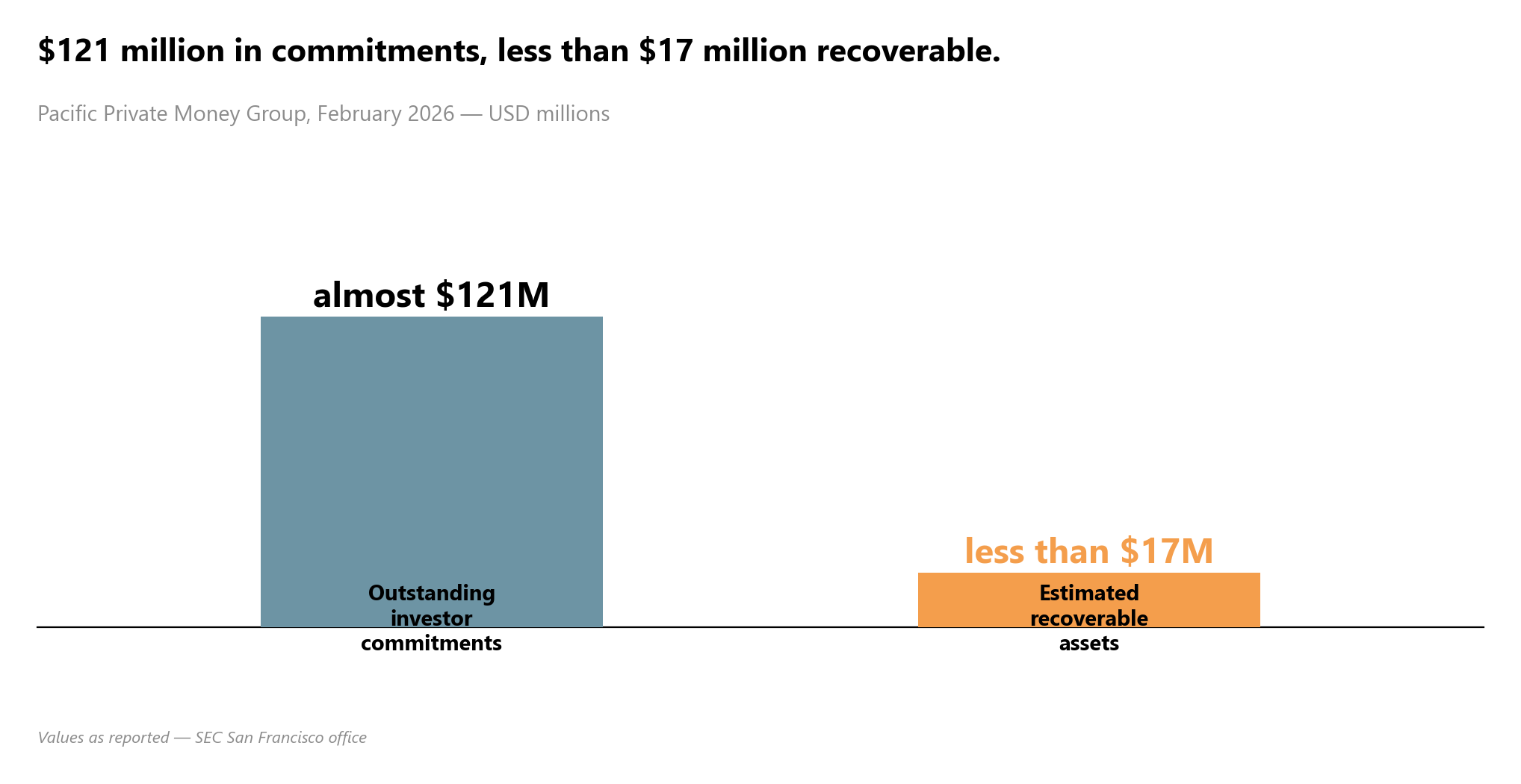
Pacific Private Money Group LLC is not a shell company with a fabricated address. It is an actual, correctly named business based in Novato, California, registered and operating under its own name. That is what makes the SEC’s September 1 complaint against former CEO Mark Hanf and former subsidiary COO Hoai-Nam Chu Phan the sharper half of this story. According to the complaint, from around December 2021 to November 2025, Hanf and Phan told roughly 190 investors, many of them retired, that capital placed in two of PPMG’s private funds would be used to originate or purchase loans secured by real estate, and that they could expect preferred or fixed returns from that lending activity. Instead, the SEC alleges, the funds paid earlier investors with money raised from newer ones, a Ponzi-like structure, while Hanf personally misappropriated more than $7 million. The scheme did not unravel because a regulator checked the funds’ books. It unraveled in the fall of 2025 because enough investors asked for their money back at once that the funds could not pay. By February 2026, said Jason Lee of the SEC’s San Francisco office, outstanding investments in the two funds stood at almost $121 million against recoverable assets estimated below $17 million.
Hanf and Phan face charges under Section 17(a) of the Securities Act and Section 10(b) of the Exchange Act, and both consented to judgment, subject to court approval, without admitting the allegations; the U.S. Attorney’s Office for the Northern District of California has filed parallel criminal charges. None of that changes the underlying problem. PPMG operated under its own name for years. Nothing in the registry that recorded its existence required an outside party to confirm that promised returns actually came from the lending business before investors’ money went in. The same absence of upfront verification that let 38 advisers the SEC now accuses of falsifying their filings onto its website also let a functioning, correctly named business run four years past the point anyone should reasonably have checked.
The other self-declared registry
Kalshi is registered with the CFTC as a designated contract market. In January 2025 it self-certified a new line of sports event contracts, using the same next-business-day mechanism described above; it had already self-certified election contracts back in June 2023, a category the courts have treated separately. Over 90 percent of Kalshi’s trades in 2025, representing 95 percent of its revenue, were sports related, according to the Ninth Circuit’s opinion.
In March 2025 the Nevada Gaming Control Board sent Kalshi a cease and desist letter demanding it stop offering both its election and sports event contracts, arguing they amounted to unlicensed gambling under Nevada law. Kalshi sued, won a preliminary injunction, lost it when the district court reversed itself, and appealed. On August 28, 2026, a three-judge Ninth Circuit panel of Ryan Nelson, Bridget Bade and Kenneth Lee ruled largely for Nevada, Lee concurring, no dissent. The board’s own press release calls the vote 3-0; the opinion itself does not use that phrase, though nothing in it contradicts the board’s count.
A version of the court’s central line has circulated widely: “The sports event contracts were not ‘swaps’ because they were sports bets.” That sentence is real, but it sits in the opinion’s staff-prepared summary, which carries its own note that it “constitutes no part of the opinion of the court.” Judge Nelson’s actual opinion, at page 41, is more careful: “we conclude that these sports event contracts are likely not swaps under the CEA.” The word likely matters, since this is an appeal of a preliminary injunction, decided on likelihood of success, not a final judgment on the merits. The court also held Kalshi’s self-certification of the sports contracts unlawful under the CFTC’s own Special Rule and its regulation, 17 C.F.R. §40.11, and wrote that the CFTC “has failed or declined to enforce” that rule. The panel agreed with the Third Circuit’s ruling in KalshiEX, LLC v. Flaherty that the Commodity Exchange Act broadly preempts state futures regulation; it disagreed only on whether sports event contracts count as swaps at all, which is why the two circuits split on the same statute. A Fourth Circuit appeal is pending, and lower courts in Tennessee, Ohio, Arizona and New York have gone different ways on the same question.
The disposition was not a clean win for Nevada. The court affirmed the dissolution of the injunction for the sports contracts, but remanded the election contracts, the one category comparable to the macro-style contracts prediction markets are best known for outside sports, back to the district court to decide in the first instance. A footnote calls the election contracts “illegal under Nevada law and a fraction of Kalshi’s business.” The category closest to the number this article ends on is the one the Ninth Circuit explicitly declined to rule on. A brief filed by 39 states and the District of Columbia, cited in the opinion, put a scale on the stakes: Americans wagered almost $150 billion on sports in 2024, per the states’ own filing, not a finding by the court.
What it means
Financial coverage regularly places Kalshi’s implied probability next to the CME’s as if the two measured the same thing. On August 28, 2026, after Federal Reserve Chairman Kevin Warsh’s Jackson Hole speech, Kalshi traders put the odds of a 25 basis point rate hike at the Fed’s September 16 meeting at 48 percent. Fed funds futures, via the CME’s FedWatch tool, showed nearly 56 percent the same day, and Polymarket traders showed 49 percent. Before Warsh spoke, the probability of the Fed holding rates steady had stood near 70 percent, a different measure of a different outcome, useful only to show how far sentiment moved.
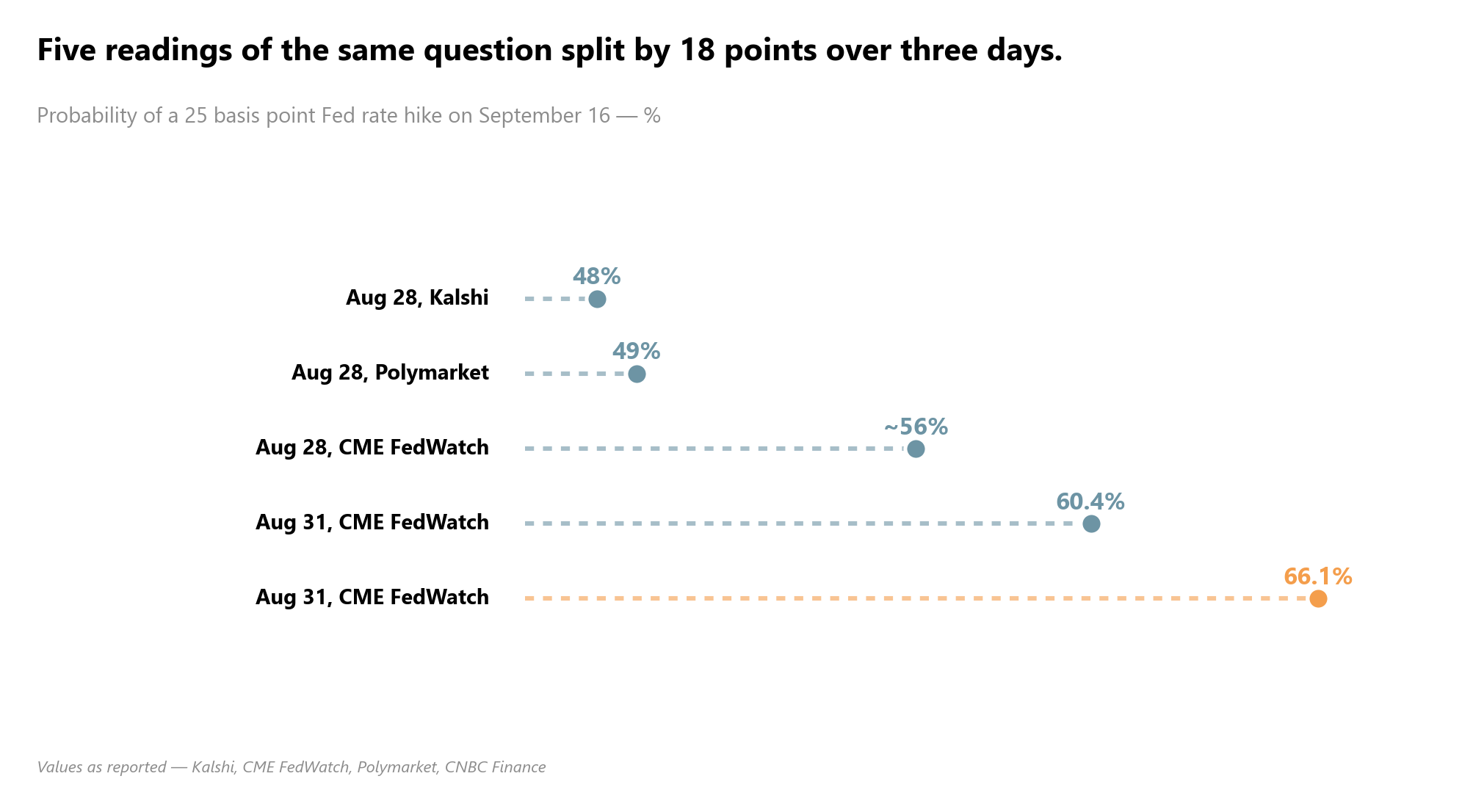
The dispersion is not only between platforms. Two CNBC articles published the same Monday, August 31, cite two different CME FedWatch readings for the same question, 60.4 percent in one and 66.1 percent in the other. Neither article says when that day its reading was taken. A 5.7 point gap between two same-day citations of the instrument treated as the clean benchmark, with no timestamp on either one, is its own kind of unverified number.
This is not the first time a number read as measuring one thing turns out to measure the apparatus behind it instead. An earlier article on this site, The Delinquency Chart Measures Lenders, Not Households, made the same point about a widely cited consumer credit chart. The Fed-odds number carries the same catch. When the 48 percent from Kalshi runs next to the CME’s number as though both were readings off the same instrument, one comes from a federally regulated futures contract, and the other from a market whose right to list the sports category was just found unlawful, and whose right to list the one category that resembles a macro contract, election contracts, sits unresolved in front of a district court. The Fed’s decision is due September 16. This is not a forecast of that decision. It is a note on how reliable one of the instruments used to read it in advance actually is.
Sources
- Kalshi Inc. v. Nevada Gaming Control Board, Ninth Circuit opinion No. 25-7516 (U.S. Court of Appeals for the Ninth Circuit)
- Ninth Circuit Rules in Favor of Nevada (Nevada Gaming Control Board)
- False Forms ADV Filings, SEC Litigation Release No. 26622 (SEC)
- SEC Charges San Francisco Bay Area Private Fund Executives with Multimillion Dollar Ponzi-Like Scheme (SEC Press Releases)
- FSB Chair Warns of Risks Arising from Frontier Artificial Intelligence (AI) Models (Financial Stability Board)
- U.S. appeals court rules against prediction markets, sets up likely fight at Supreme Court (CNBC Finance)
- September Fed decision is now a coin flip as rate hike odds increase post Warsh (CNBC Finance)
- Markets see Warsh endorsing a rate hike in September. Not everyone is convinced (CNBC Finance)
- Jackson Hole analyst roundup: Warsh’s speech sends hike chances higher, may put Fed ‘at odds’ with Treasury (CNBC Finance)
- The Delinquency Chart Measures Lenders, Not Households (Count2Three)