On October 5, CME Plans to Price the Collateral Behind AI's Debt
On October 5, pending regulatory approval, CME Group plans to list the first futures contracts tied to the hourly rental price of an Nvidia H100 chip. The real story here is collateral, not chips.

On October 5, pending regulatory approval, CME Group plans to list the first futures contracts tied to the hourly rental price of an Nvidia H100 chip. The real story here is collateral, not chips: the same week Nvidia and six of the world’s largest asset managers unveiled a plan to mobilize more than $500 billion against GPUs as loan collateral, the asset behind that debt got something it never had before, a public, tradable price.
What Makes a Machine “Financeable”
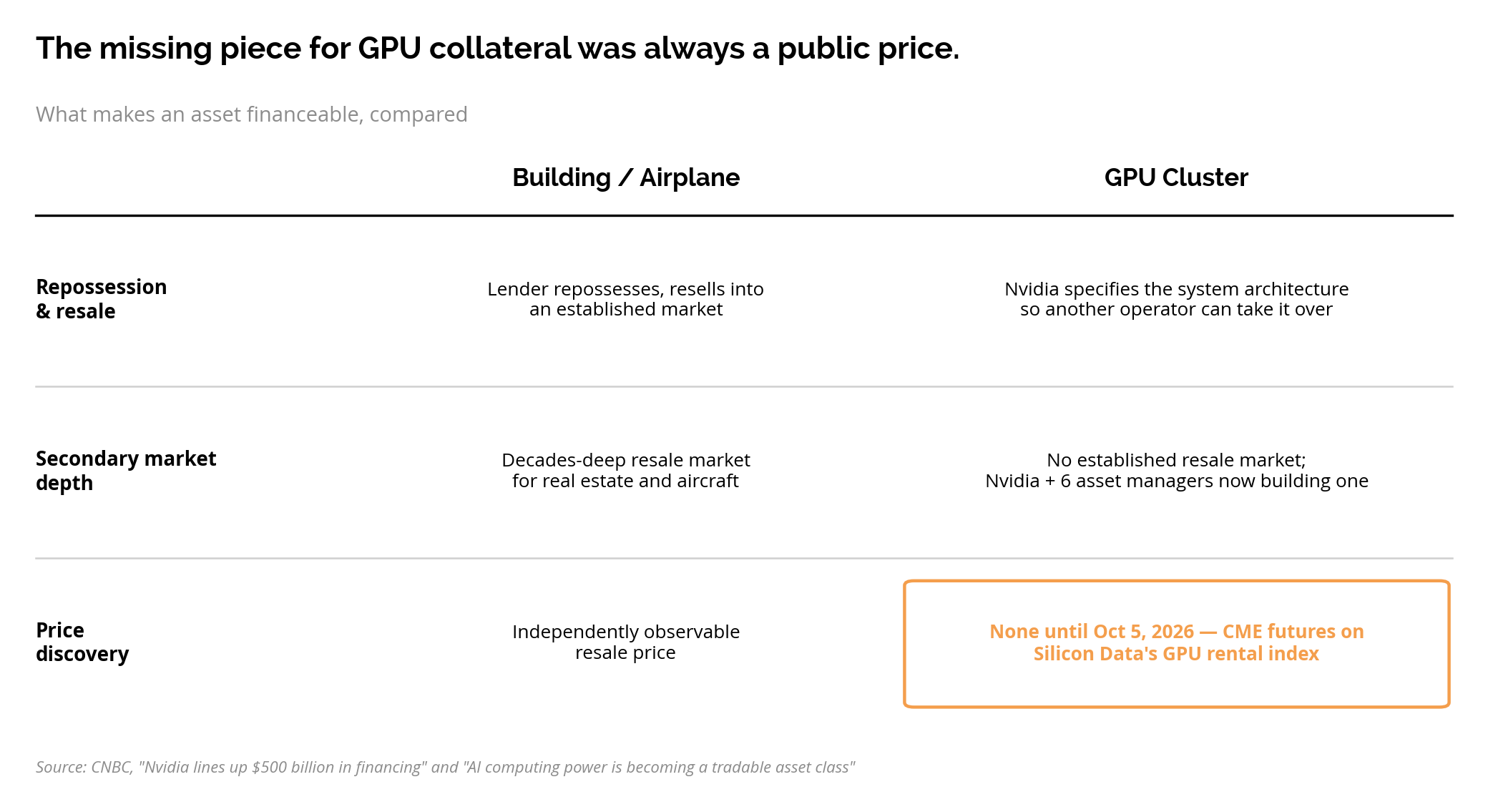
Standard asset-backed lending rests on a simple mechanism. A bank extends credit against a physical asset such as a building, a warehouse, or a cargo ship because if the borrower defaults, the lender can repossess that asset and resell it into an established secondary market with an independently observable price. That mechanism is what makes a commercial building or an airplane bankable. It has rarely applied to computer chips.
GPUs have historically been treated as fast depreciating IT equipment. New chips power the training of frontier AI models, then within a few years are relegated to lower margin inference work, a shift that affects their resale and collateral value. “Depreciation is the one key risk here,” said Ben Emons, founder of FedWatch Advisors, who structured similar asset backed loans for IndyMac before joining Pimco as a portfolio manager. Nvidia chips “could depreciate faster than expected,” he said.
Jensen Huang argues that risk is overstated. “Nvidia’s AI factory platform is really an investable asset, an infrastructure asset,” the Nvidia CEO said. “The reason for that is because it’s productive, it’s revenue generating, it is fungible, it’s used by just about every cloud service provider, it runs every AI model.” In a separate interview announcing the plan, he called the chips simply “productive,” “long lived,” “fungible,” and “flexible.”
That claim, that Nvidia’s chips behave like infrastructure rather than consumer electronics, is the premise the rest of the deal rests on.
Inside the Deal: Who Guarantees the Collateral, Who Prices It
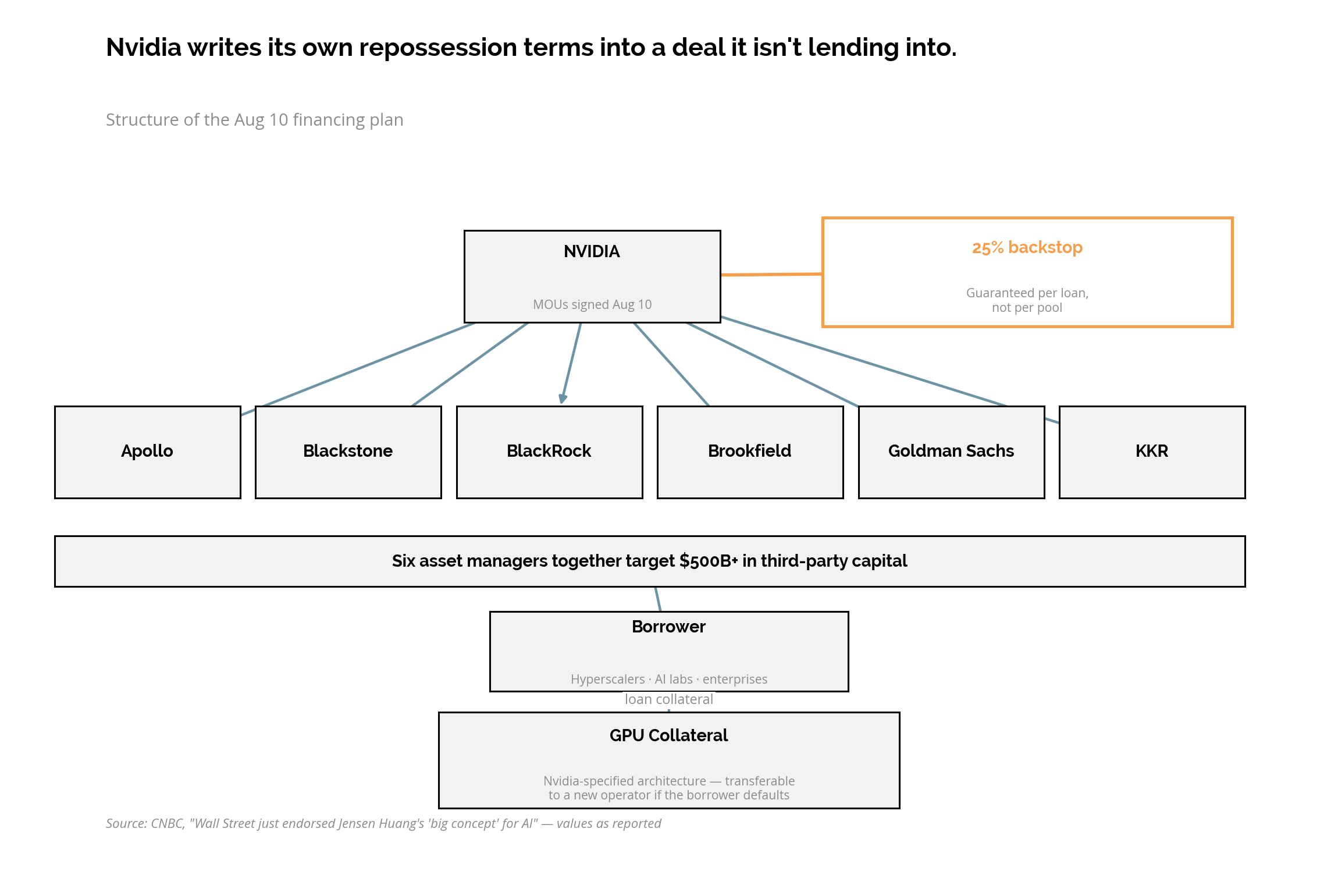
On August 10, Nvidia signed memorandums of understanding with six of the world’s largest asset managers, Apollo Global Management, Blackstone, BlackRock, Brookfield Asset Management, Goldman Sachs, and KKR, to build financing platforms for its customers. Together, the group is aiming to mobilize more than $500 billion in third party capital for hyperscalers, frontier AI labs, and enterprises building data centers and buying hardware.
Two structural details matter more than the headline number. First, Nvidia will have the option to backstop 25% of every individual loan, not 25% of the total pool, a guarantee designed to produce more favorable interest rates for borrowers that would otherwise have to rely on their own credit rating. Second, borrowers will be required to use system architectures specified by Nvidia, so that “another company can take it over and operate it if something were to happen,” Huang said. That second clause is Nvidia writing its own repossession terms into a deal it is not lending into directly, an unusual position for the seller of the underlying asset.
BlackRock CEO Larry Fink framed the moment in his own terms. “This is the very beginning, like what it was when I started in the mortgage backed securities market in the 1970s,” Fink said. “I look upon this as a next future for financial engineering.” That is Fink’s analogy, not a claim the deal itself makes, and it points to the earliest, least distorted version of a securitization market rather than the one that later produced the 2008 crisis.
Goldman Sachs CEO David Solomon put the underlying logic more plainly. “You’re starting to see, in a sense, you know, asset based financing against this infrastructure build out,” Solomon said. “That’s not surprising because these are real assets. They have real value.”
The Missing Piece Just Arrived: A Public Price
Fink’s own analogy points to what has been missing. Mortgage backed securities did not become a market because someone declared houses financeable. They became one once a public index let someone price, hedge, or bet against the underlying asset. That is what CME Group and Silicon Data are now building for GPUs.
Beginning October 5, pending regulatory approval, CME will list futures contracts tied to the hourly rental cost of Nvidia’s H100 and newer Blackwell B200 chips, benchmarked to Silicon Data indexes that track GPU rental prices. Each contract represents a month’s rent for an H100. “For years, two companies buying the exact same GPU capacity could pay wildly different prices with no way to know who got the better deal. They will now have a benchmark to check that against,” said Carmen Li, CEO of Silicon Data. “Compute futures give the market something it’s never had: a public, tradable reference price for the resource every AI system runs on.”
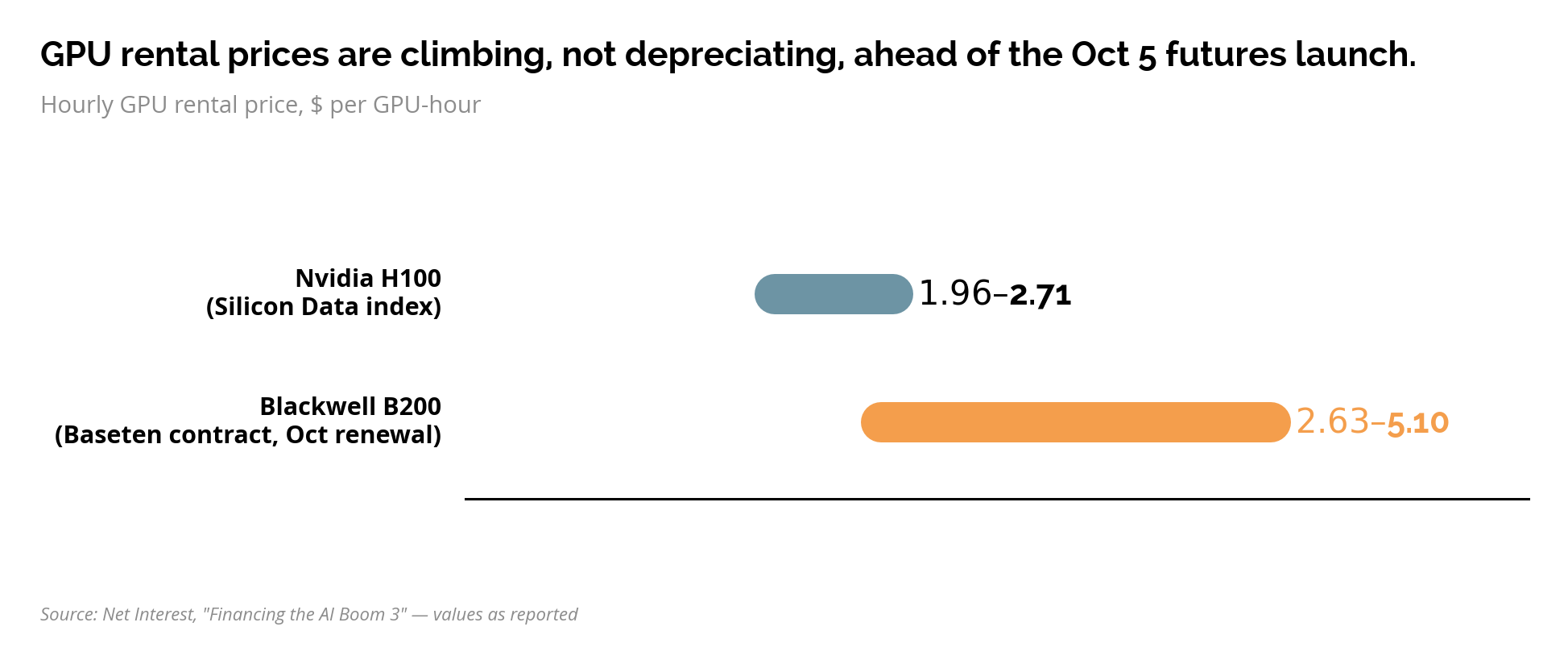
The price evidence available right now supports Huang’s case, at least so far. According to Silicon Data figures cited by the newsletter Net Interest, the hourly cost to rent an Nvidia H100 has risen from $1.96 at the end of November to $2.71, with forward rates curving upward into 2027 and 2028. Baseten, a provider of software and computing capacity for companies running lower cost AI models, said the cloud provider behind its Blackwell B200 GPUs will raise the rental price from $2.63 an hour to $5.10 when its contract renews in October. Even older chips are appreciating. CoreWeave said this week on its earnings call that it has signed a contract to lease Nvidia Ampere A100 chips, first introduced in 2020, all the way out to 2029 at “an attractive price.” CoreWeave’s CFO added that the company remains “largely sold out of prior generations of NVIDIA GPUs in addition to the current SKUs.”
Nvidia’s own explanation for that durability rests on software, not silicon. “CUDA gives developers and NVIDIA engineers a common platform to continually upgrade Ampere, Hopper and Blackwell throughout their useful lives,” Huang said. “CUDA makes NVIDIA computing versatile. Versatility makes it fungible. Fungibility drives utilization and extends durability, making NVIDIA compute a productive asset: rentable, durable and financeable.”
The Counter Argument, Priced in Yield and in One Downgrade
Not everyone treats Nvidia’s chips as real estate. Ben Emons believes investors should price GPUs as high depreciation equipment instead, and expects them to demand yields of 11% to 17% depending on where they sit in the capital structure. Separately, a Bank of America Securities note points out that the borrowers behind these loans will mostly be non investment grade firms locked out of traditional debt markets, AI startups and neoclouds. These are two distinct claims from two distinct sources, not one combined figure.
The named downside risk is China. Huawei, the dominant domestic supplier of Chinese AI chips, has been on the US Commerce Department’s Entity List since 2019, and in May the US government ruled that Huawei’s Ascend chips violate American export controls. Nvidia’s roughly 75% share of the US AI chip market, by most estimates, is the buffer against a Chinese price war, not a guarantee against one. Emons argues that if Chinese producers flood the market with cheap silicon, the collateral behind hundreds of billions in loans could lose value faster than the debt matures.
For now, the pricing data still leans toward Huang’s argument, even by a second, more conservative measurement. Huang has cited a separate figure showing H100 rental rates climbing from roughly $1.70 per GPU hour in late 2025 to about $2.35 this year, a different series from the Silicon Data numbers above but pointing in the same direction.
The live counter signal sits elsewhere, on Oracle’s balance sheet. S&P Global Ratings downgraded Oracle’s long term issuer credit rating to BBB- from BBB in July, one notch above junk, and Moody’s holds a negative outlook on the company. Oracle’s fiscal 2026 free cash flow came in at negative $23.7 billion. Long term debt climbed from $85.3 billion to $122.3 billion over the year, and net property, plant and equipment more than doubled, from $56.7 billion to $129.6 billion. Gross margin has fallen from 80.6% in 2021 to 65.8% in fiscal 2026. S&P expects Oracle’s cloud infrastructure business, which made up 27% of revenue in fiscal 2026, to balloon to almost 60% of revenue by fiscal 2028, a shift S&P called riskier than Oracle’s legacy software business because it demands heavy upfront investment before any payoff arrives.
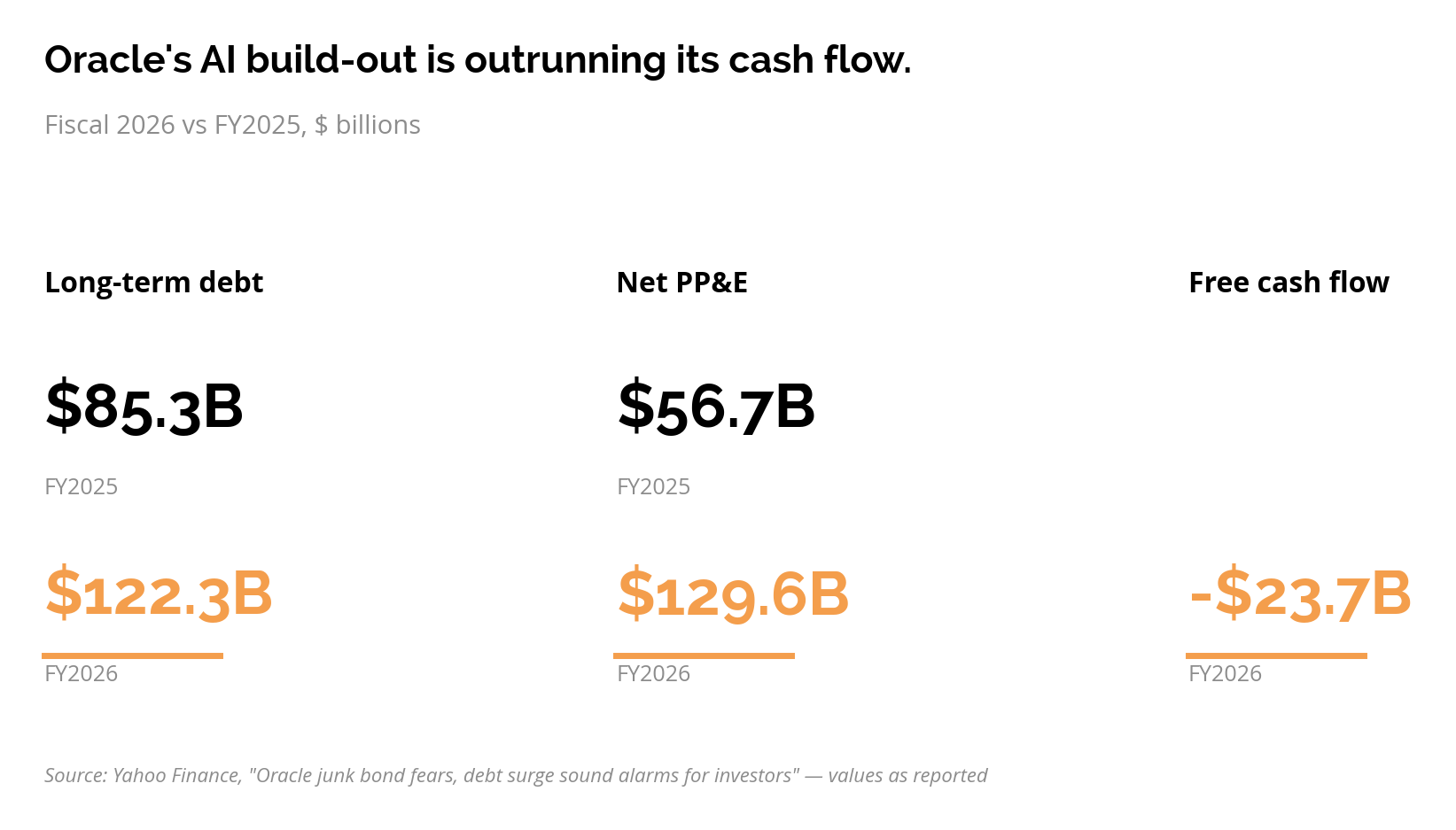
Oracle is not one of the six asset managers in Nvidia’s financing plan, and its debt is not GPU collateralized in the way the new structure envisions. It is the clearest live example of a balance sheet betting heavily on AI infrastructure before revenue catches up, and the kind of downgrade the futures market will now price in real time.
What It Means
Both sides of this story are betting on the same thing, that GPUs hold value like infrastructure rather than depreciate like consumer electronics. What changes on October 5 is that the bet gets a public price attached to it, updated in real time rather than argued about on earnings calls and CNBC panels. That price can vindicate Huang’s case every quarter it climbs, or become a precise instrument for anyone betting against it. Michael Burry already is, holding bearish positions against Nvidia and the broader semiconductor sector on the theory that a meaningful share of AI demand is financed through arrangements he calls circular rather than driven by end customers.
Steve Eisman’s read sizes the exposure sitting behind that price. OpenAI and Anthropic together account for roughly 70% of AI related revenue at Microsoft, Amazon, Google, and Oracle combined, and for 25% to 35% of those companies’ cloud revenue, according to Eisman. “The futures of these massive companies, in a sense, are a bet that OpenAI, Anthropic are going to succeed,” he said. A meaningful share of whatever the CME contract ends up pricing, in other words, is downstream of two private companies continuing to grow into their valuations.
The stakes extend well past the chip trade. Research from the Bank of England’s Bank Underground blog estimates that a 1% negative earnings surprise across the Magnificent Seven pulls the S&P 500 down by close to 2%, drags the FTSE 100 down by about 1% within two days, and widens US credit spreads by 5 to 10 basis points over three weeks. Unlike the 2008 financial crisis, the researchers found, the dollar depreciates rather than benefiting from a flight to safety, a sign investors would read an AI disappointment as a hit to future productivity, not a reason to seek shelter in US assets.
October 5 is when this thesis starts trading.
Sources
- Nvidia lines up $500 billion in financing as CEO Jensen Huang tells CNBC his chips are ‘investable asset’ (CNBC)
- Wall Street just endorsed Jensen Huang’s ‘big concept’ for AI. What now? (CNBC)
- Why Jensen Huang’s $500 billion AI financing plan faces a big risk from China (CNBC)
- Financing the AI Boom 3 (Net Interest)
- AI computing power is becoming a tradable asset class as CME launches futures contracts (CNBC)
- Oracle junk bond fears, debt surge sound alarms for investors (Yahoo Finance)
- ‘Big Short’ investor Steve Eisman sees an Achilles’ heel in the AI boom (CNBC)
- If AI disappoints? The transmission of US big-tech earnings news (Bank Underground)