As US Productivity Growth Doubles, Listed-Firm Operating Margins Reach 18%
US labor productivity has grown twice as fast since 2019 as in the 2010s. A New York Fed economist finds part of that gain in wider margins at listed firms, in a study that never invokes AI.

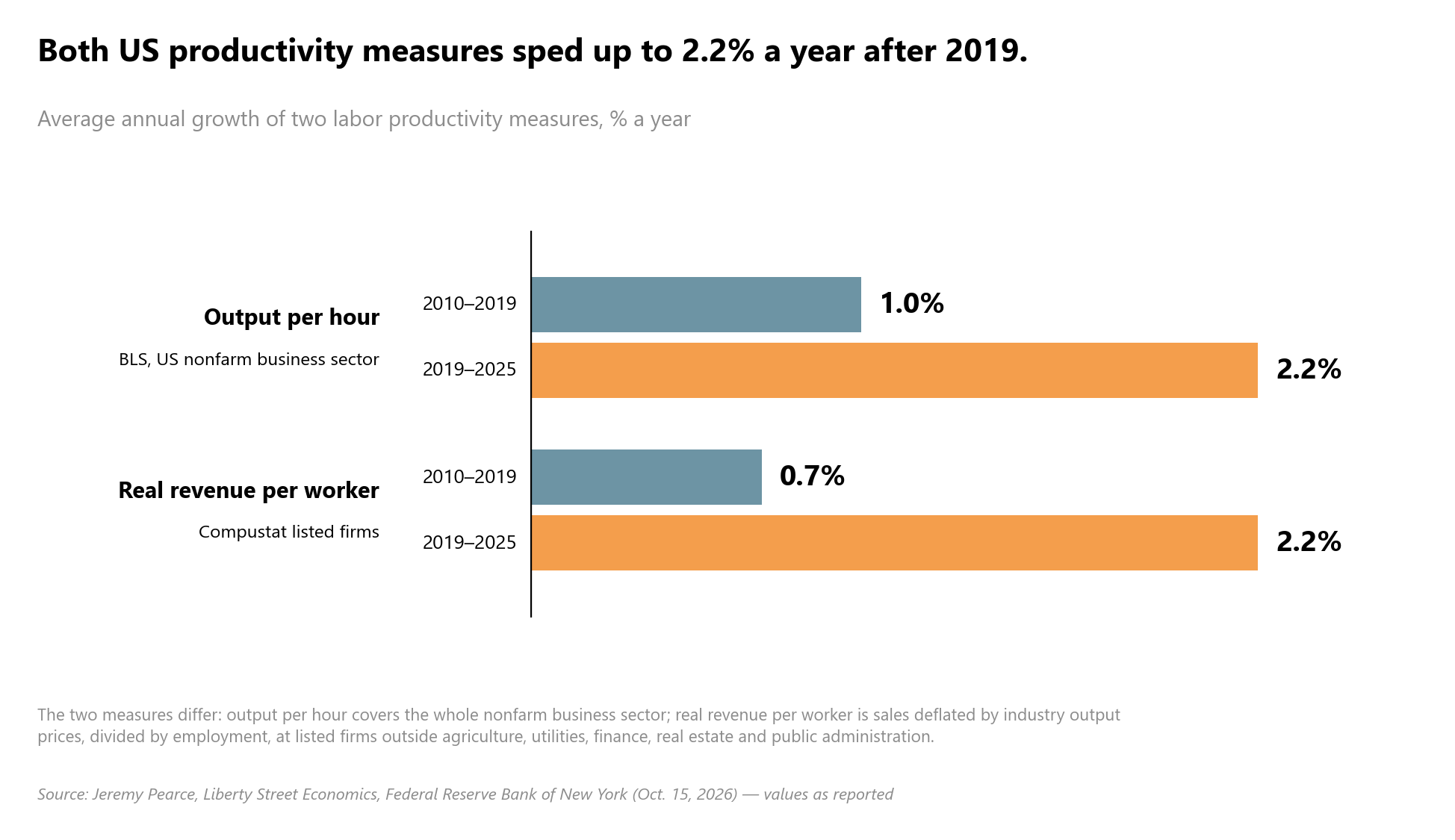
Since 2019, output per hour in the US nonfarm business sector has grown 2.2% a year, against 1.0% a year in the 2010s. Jeremy Pearce, a research economist at the Federal Reserve Bank of New York, now finds part of that gain in the wider profit margins of listed US companies. Who keeps a productivity gain decides whether faster growth reaches paychecks or profits, and company filings already show the profit side of this one.
Who keeps a productivity gain
A productivity gain means more output for each hour or each worker. It does not, by itself, say who ends up with the extra value. Pearce makes that point plainly in an October 15 post on Liberty Street Economics, the New York Fed’s research blog, whose disclaimer notes that the views are not necessarily the bank’s: higher revenue per worker does not tell you who gains from it. The extra revenue can go to employees, when firms compete for staff by raising pay, or it can stay with the firm as profit.
Margins are how Pearce tells the two apart. A profit margin is profit divided by sales, the share of each sales dollar a firm keeps after paying its costs. The gross margin subtracts the direct cost of making what was sold. The operating margin also subtracts overhead, which in Compustat, the database of listed companies’ accounts that Pearce works from, typically includes research and development. His figures come from the firms’ annual 10-K filings. The test follows from the definition: if productivity gains were flowing to profits, margins should show it.
The pace doubled, the level did not
Before asking where the gain went, Pearce establishes that there is one. Nonfarm business output per hour, as measured by the Bureau of Labor Statistics, grew 1.0% a year from 2010 to 2019, down from about 3% in the late 1990s, with the slowdown especially marked in manufacturing. From 2019 to 2025 it grew 2.2% a year. In Pearce’s words, growth has picked up to “twice the 2010s rate, around 2 percent.”
What doubled is the annual rate, not the level of output per hour. Since 2019, US productivity has grown at an average annual pace about twice the one it managed from the Great Recession to 2019.
Pearce’s listed companies show the same turn. He studies Compustat firms in manufacturing and services from 2010 to 2025, leaving out agriculture, utilities, finance, real estate and public administration, where productivity is hard to measure. His firm-level gauge is real revenue per worker: sales, deflated by each industry’s output prices, divided by employment. It grew 0.7% a year from 2010 to 2019 and 2.2% a year from 2019 to 2025.
The two 2.2% figures measure different things. One is output per hour across the whole nonfarm business sector. The other is deflated sales per employee at listed firms in a narrower set of industries. Pearce claims only a “similar qualitative” acceleration between them, and on that basis concludes that “the labor productivity uptick is real.” With the gain established at firm level, the margin test can be run on the same firms.
Where part of the gain surfaced
The margin test answers a question that comes before the one in US Firms’ $904 Billion Q2 Profit Masks S&P 500’s 22-Year Payout Low, where we looked at how listed US companies split their cash between capital spending and shareholder payouts. Pearce’s question is whether margins at listed firms widened at all, and by how much.
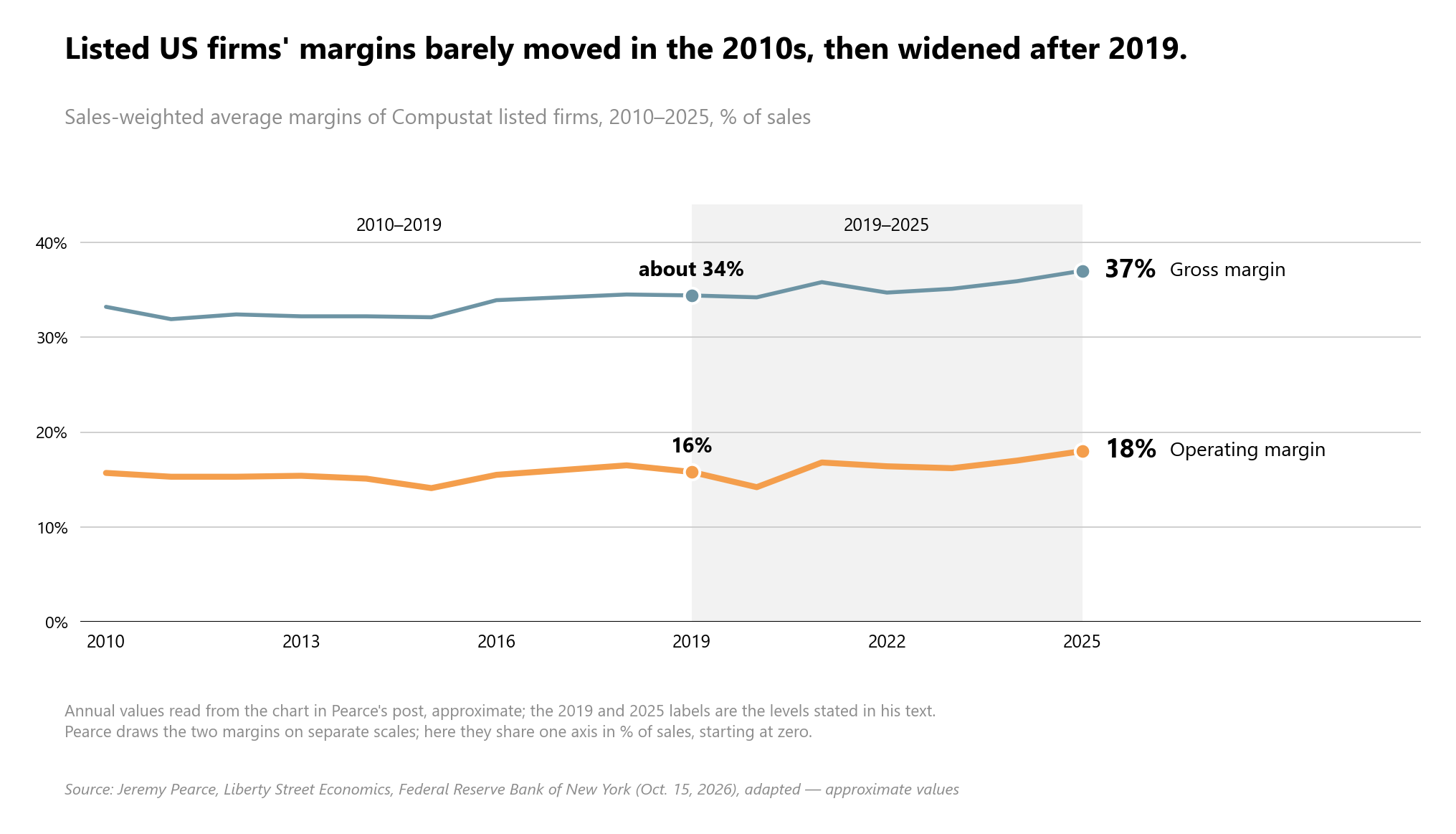
Through the 2010s, those margins were flat in Pearce’s description: the gross margin ratio grew about 0.4% a year and the operating margin was roughly unchanged. Between 2019 and 2025 both turned up. On average, weighted by sales, the gross margin rose from about 34% of sales to 37%, and the operating margin from 16% to 18%.
Pearce also states the change as growth in the ratio itself: 1.3% a year for the gross margin and 2.4% a year for the operating margin. Those are rates of growth rather than percentage points. Because the averages are weighted by sales, the companies with the largest sales count most in them.
Pearce’s conclusion stays within what those numbers show. “Part of the gains surfaced with wider profit margins,” he writes, adding that on a reasonable baseline the operating margin rose more than 2% a year over 2019 to 2025. He does not measure wages, so he does not say how much of the gain reached workers. His only sentence on the labor share reads: “The increase in profit margins is consistent with ongoing declines in the labor share of output.” The labor share, the portion of output paid out to workers, is not estimated in the post. Pearce treats its decline as ongoing, gives no figure or period for it, and claims only that wider margins are consistent with it.
Pearce then asks which firms gained most. Firms whose R&D spending relative to sales was 10% higher in 2019 saw about 0.7% faster growth in operating markups over 2019 to 2025, and 0.5% faster over 2022 to 2025. Firms with higher capital intensity showed no similarly significant pattern. Pearce reads this as consistent with returns to intangible investment rather than to physical capital, and sees a “potentially important role” for technology and intangibles in driving markups.
Pearce stops short of saying what those wider margins are. “Whether these rising margins are returns to significant investment in intangibles or purely a windfall for firms is a topic to explore in future work,” he writes. The answer decides how the margins should be read: as a return on investment firms had already made, or as income the productivity gain simply handed them.
The AI debate is mostly about exposure
The word AI does not appear in Pearce’s post. His explanatory vocabulary is technology and intangibles, and his window closes in 2025. In the same week, the IMF, the World Bank’s Jobs Council and the European Central Bank discussed productivity and jobs mostly through AI, and mostly in the future tense.
In its latest global growth report, released at the IMF and World Bank annual meetings in Bangkok, the International Monetary Fund describes AI investment as “a large, front-loaded demand shock,” according to CNBC. CNBC’s summary of the report adds that the money is pouring into semiconductors, data centers and power generation before any broad productivity gains have materialized.
The European Central Bank sees adoption running ahead of any measurable effect on aggregate productivity. In Dublin on October 13, Philip Lane, a member of the ECB’s Executive Board, said that in the ECB’s survey of households, 52% of workers now report using AI at work, against 26% in 2024. Those workers report significant time savings, concentrated in specific sectors and in tasks such as coding. Lane still judged it “too early to detect any material impact on aggregate productivity.” His remarks concern the euro area, and he noted that US workers spend two to three times as much of their working week using AI as workers in the largest euro area economies.
The jobs discussion in Bangkok was about exposure. On Monday, October 12, IMF Managing Director Kristalina Georgieva told a panel there, as CNBC reported, that AI is hitting the global labor market like a “slow-moving tsunami,” with young graduates first in line. The IMF estimates that about 40% of jobs worldwide will eventually be augmented, downgraded or eliminated, and Georgieva put exposure at about 60% in advanced economies. The count includes jobs that AI makes more productive, so it measures exposure rather than losses.
On the same panel, Singapore President Tharman Shanmugaratnam, who co-chairs the World Bank’s Jobs Council, said that in the US “for the first time in a century, demand for graduates has gone down,” and that the wage premium for a college degree is shrinking too. Shanmugaratnam made the claim on stage, and CNBC reported it without supporting data.
Company evidence is harder to read. Bank of America CEO Brian Moynihan told analysts on October 14 that the bank runs about 130 internal AI projects, with savings expected to rise from $300 million this year to $700 million in 2027, according to CNBC. Moynihan also said the bank’s head count fell by about 3,400 over the past year as it cut roughly 5% of its managers. CNBC notes that it is unclear how much of that reduction is due to AI, so the savings and the smaller head count sit side by side without a measured link.
One older study did link a technology to both jobs and pay. A 2022 paper by Marcus Dillender and Eliza Forsythe, cited by CNBC, found that when companies adopted software for office and administrative work, employment in the sector fell 1% while wages for college graduates rose 3%. The study concerns office software rather than AI.
Pearce measures the US gain without mentioning AI and finds part of it in listed firms’ margins. The IMF, the ECB and the Bangkok panel discuss AI mostly in terms of exposure and gains still to come.
What it means
The productivity acceleration that institutions expect from AI already has a recent US counterpart in the 2019 to 2025 pickup, and part of that gain settled in the margins of listed companies. Pearce’s data show that the profit side of a productivity gain can be measured before anyone attributes the gain to AI.
The channel to watch is one Lane named, conditionally and for Europe. The potential for AI to replace some types of workers, he said, “may also weaken the bargaining power of workers, moderating wage growth and reducing the labour share in total income.” Lane offered it as a possibility, with no estimate attached. It points the same way as the “ongoing declines” in the labor share that Pearce says his US margins are consistent with.
The other thing to watch is Pearce’s unanswered question. If the wider margins are a return on years of research spending, they reward investment firms had already made. If they are a windfall, the argument over the labor share gains a concrete target in listed companies’ accounts. For anyone tracking AI and jobs, the next numbers worth having are a measured US labor share for 2019 to 2025 and Pearce’s answer on returns versus windfall, ahead of another estimate of how many jobs AI might touch.
Sources
- Revenue per Worker Is Up. Are Firms Getting a Larger Share? (Liberty Street Economics)
- IMF sees milder global slowdown as AI boom offsets war hit, warns resilience is nearing limits (CNBC Markets)
- Philip R. Lane: The AI opportunity for Europe (ECB Press)
- World Bank jobs council urges ‘crisis-era’ employment support measures as IMF warns of AI ‘tsunami’ (CNBC Markets)
- Bank of America hired 1,000 contractors to patch software flaws exposed by Anthropic’s Mythos (CNBC Finance)
- Women may be at greater risk of AI job losses. Telephone switch operators and PCs show why (CNBC Markets)
- US Firms’ $904 Billion Q2 Profit Masks S&P 500’s 22-Year Payout Low (Count2Three)